
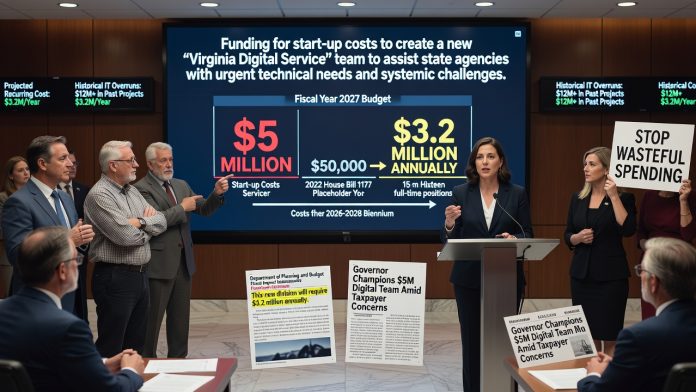
The newly proposed fiscal year 2027 state budget introduces a massive financial commitment by allocating $5 million in start-up costs for a brand new government technology team. This initiative, known as the Virginia Digital Service, aims to address systemic technical challenges across various state agencies. However, this substantial funding request raises immediate concerns among fiscal conservatives regarding unnecessary government expansion and the irresponsible use of taxpayer dollars. Rather than streamlining existing operations, the state is choosing to throw millions of dollars at bureaucratic inefficiencies.
Expanding the State Bureaucracy
The Virginia Digital Service is slated to be established under the Virginia Information Technologies Agency, adding yet another layer to an already complex state government. According to earlier fiscal impact estimates from the Department of Planning and Budget, this new division will require $3.2 million annually to support sixteen full-time equivalent positions. Taxpayers are now being asked to fund a completely new department to solve urgent technical needs that the existing IT infrastructure has seemingly failed to manage. Creating a dedicated digital services team to fix long-unresolved technical challenges highlights a glaring failure in current state agency management. Fiscal responsibility dictates that state agencies should fix internal inefficiencies through better management rather than demanding millions in new funding to hire additional staff.
A History of Ballooning Costs
The financial trajectory of the Virginia Digital Service demonstrates a troubling pattern of budget expansion over a very short period. During the 2022 legislative session, a similar proposal under House Bill 1177 only received a modest $50,000 placeholder amendment. The current 2026-2028 biennium budget marks a drastic departure from that initial restraint, ballooning the cost to a fully funded $5 million initiative. This massive increase represents a staggering leap in taxpayer liability for a project that previously warranted minimal financial commitment from state lawmakers.
Questioning the Governor’s Justifications
Governor Abigail Spanberger publicly championed this expensive new initiative during a press address on June 29, 2026. The governor stated she was excited that the budget included her proposal to create a dedicated digital services team to deliver services more efficiently to families and stand up new systems. While the goal of making government work better sounds appealing, the reality is that taxpayers are footing a massive bill for basic operational duties. State agencies should inherently possess the capability to deliver services efficiently without requiring a specialized, multi-million-dollar rescue team to fix their persistent technical issues.
The Threat of Long-Term Overspending
The initial $5 million allocation is merely the tip of the iceberg when it comes to the long-term financial burden this new agency will impose on Virginia residents. With a projected recurring cost of $3.2 million every year to maintain the sixteen newly created positions, the total expense will quickly compound over future budget cycles. Government programs of this nature notoriously suffer from mission creep, where initial start-up costs inevitably lead to requests for even larger budgets down the road. Fiscal conservatives understand that once a new government team is established and staffed, it becomes nearly impossible to dismantle or defund. This permanent expansion of the state payroll directly contradicts the principles of reducing the budget and saving taxpayer money.
Demanding Accountability in IT Spending
State technology projects have historically been a prime breeding ground for massive cost overruns and continuous administrative delays. By injecting $5 million of start-up capital into the Virginia Digital Service, the state is risking yet another expensive technological boondoggle at the expense of hard-working citizens. Taxpayers deserve strict oversight mechanisms to ensure that this newly formed team actually resolves the systemic challenges it was created to address. If these sixteen new employees fail to produce measurable cost savings across other state agencies, the entire initiative will prove to be nothing more than a wasteful bureaucratic exercise.
Protecting the Virginia Taxpayer
At a time when everyday Virginians are tightening their own household budgets, the state government must exercise the exact same financial discipline. Throwing millions of dollars at systemic service delivery issues is a classic example of wasteful government spending that fails to address the root causes of the problem. A thorough audit of the Virginia Information Technologies Agency should be conducted to reallocate existing funds before a single new tax dollar is spent on this project. Lawmakers must heavily scrutinize the 2026-2028 biennium budget to identify areas where fraud, waste, and overspending can be aggressively eliminated. True government efficiency is achieved by cutting unnecessary bureaucracy and demanding accountability from existing departments, not by writing a $5 million check to create a brand new one.