
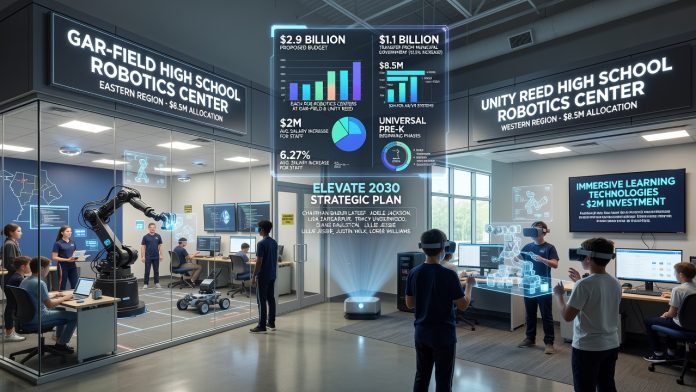
The Prince William County Public Schools system is set to advance its technological capabilities through a newly proposed $2.9 billion budget for the upcoming fiscal year. This substantial financial plan includes significant allocations for state-of-the-art robotics centers and immersive learning technologies aimed at modernizing the educational experience. The comprehensive funding package also introduces the beginning phases of universal pre-kindergarten and provides notable salary increases for district staff. These initiatives represent a major shift toward future-focused education within the region.
The Prince William County School Board is overseeing these major educational investments as part of the broader Capital Improvement Program extending over the next five years. The current board consists of Chairman Babur Lateef, Adele Jackson, Lisa Zargarpur, Tracy Underwood, Diane Raulston, Lillie Jessie, Justin Wilk, and Loree Williams. Together, these elected officials are working to implement the newly established Elevate 2030 Strategic Plan across the district. Their collaborative efforts aim to ensure that the allocated funds directly enhance student learning outcomes and facility modernization.
Major Investments in Robotics and Technology
A focal point of the new budget is the creation of two dedicated robotics centers designed to serve students on opposite ends of the sprawling county. The district has allocated $8.5 million for a specialized facility at Gar-Field High School to serve the eastern region, alongside an identical $8.5 million investment for Unity Reed High School in the west. Official budget documents describe these facilities as being expressly designed to provide dedicated, state-of-the-art robotics learning spaces for students pursuing advanced science and engineering pathways. By placing these centers in distinct geographical areas, the district intends to maximize accessibility for high school students interested in specialized technical training.
Funding for these specialized robotics facilities was secured through a strategic reallocation of capital resources rather than the issuance of new municipal debt. District planners redirected cost savings generated by the recent cancellation of the previously planned fourteenth high school construction project. This strategic pivot ultimately saved a net total of $191 million compared to prior iterations of the Capital Improvement Program, freeing up essential capital for targeted technological upgrades. The redirected funds allow the school system to enhance existing facilities without placing an additional tax burden on local residents.
In addition to the physical robotics centers, the district is heavily investing in digital infrastructure through a $2 million allocation for Augmented Reality and Virtual Reality systems. Official budget messages emphasize that these funds will support the thoughtful integration of artificial intelligence and immersive technologies to create personalized and adaptive learning environments. Administrators anticipate that these modern tools will allow educators to tailor instruction more effectively to individual student needs across various grade levels. This digital expansion ensures that classrooms remain equipped with the latest educational software and hardware required for twenty-first-century learning.
Financial Transfers and Staff Compensation
To support these ambitious educational initiatives, the school system will receive a massive infusion of capital directly from the local municipal government. The budget outlines a $1.1 billion transfer to Prince William County Schools, representing a 12.5 percent increase, or $123.8 million, over the previous fiscal year. This significant revenue boost comes despite a projected net decrease of 624 students, representing a minor enrollment drop of less than one percent compared to the approved budget of the prior year. The increased per-pupil funding ratio is expected to provide administrators with greater flexibility in deploying new technological resources.
A considerable portion of the increased operational funding will be directed toward improving compensation for the educational professionals working within the school system. The financial plan includes an average salary increase of 6.27 percent for all district employees to maintain competitive wages in the broader metropolitan region. Specifically, certified staff members will see a 6.5 percent raise, while classified staff members are slated to receive a 6.2 percent pay bump under the current proposal. These compensation adjustments are designed to improve staff retention and attract highly qualified educators to the rapidly modernizing district.
Strategic Vision and Future Outlook
The comprehensive budget aligns directly with the district’s long-term operational goals outlined in the Elevate 2030 Strategic Plan. School Board Chairman Babur Lateef publicly expressed his gratitude for the extensive preparation work completed by the staff and superintendent regarding this year’s financial planning. He emphasized that the budget will successfully initiate the funding of the strategic plan, specifically highlighting the beginnings of universal pre-kindergarten and ongoing classroom support for students and teachers. Lateef confirmed his full support for the budget, noting that the planned initiatives will bring exciting new opportunities to the local educational landscape.
As the district moves forward with the Capital Improvement Program covering the next five years, these technological and structural investments will begin taking tangible physical shape. The integration of advanced robotics centers and immersive digital learning tools reflects a broader educational shift toward preparing students for a rapidly evolving modern workforce. Community members and educational stakeholders will continue to monitor the rollout of these initiatives as the fiscal year progresses and the strategic plan is fully activated. The combination of facility upgrades, technological integration, and staff investments positions the school system for a transformative period of growth.
Email the School Board at:
Babur B. Lateef, M.D. (Chairman At-Large) — blateef@pwcs.edu,
Richard M. Jessie (Vice Chairman, Occoquan District) — rjessie@pwcs.edu,
Erica C. Tredinnick (Brentsville District) — etredinnick@pwcs.edu,
Lisa A. Zargarpur (Coles District) — lzargarpur@pwcs.edu,
Jennifer T. Wall (Gainesville District) — jwall@pwcs.edu,
Tracy L. Blake (Neabsco District) — tblake@pwcs.edu,
Justin David Wilk (Potomac District) — jwilk@pwcs.edu,
Loree Y. Williams (Woodbridge District) — lwilliams@pwcs.edu,