
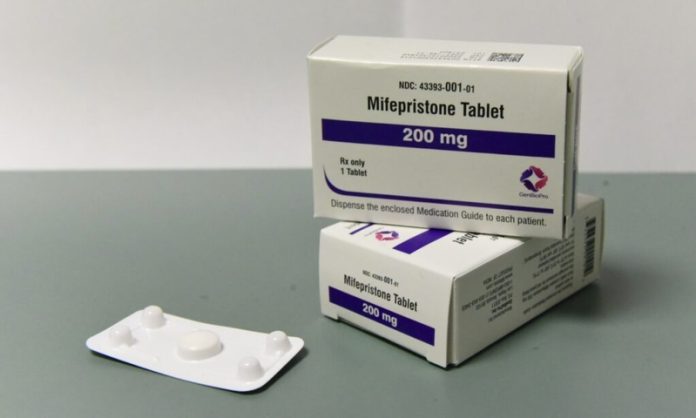
A federal judge in Virginia ruled Thursday that the U.S. Food and Drug Administration did not sufficiently justify restrictions imposed in 2023 on a drug used to terminate early pregnancies, adding another layer of complexity to a string of legal cases with opposing goals that could affect future abortion access.
The lawsuit was filed in 2023 by abortion providers in Kansas, Montana and Virginia to challenge the restrictions as excessive, unwarranted and inconsistent with other legal requirements. A similar case in Hawaii was already decided in October, with a federal judge also finding that the restrictions were arbitrary.
In Virginia, U.S. District Court Judge Robert Ballou, an appointee of former President Joe Biden, said the FDA failed to conduct an appropriate review of the 2023 restrictions on mifepristone, which include rules that prescribing pharmacies and clinicians must be specially certified and prescribers and patients must sign a form acknowledging the medication’s risks.
“The 2023 REMS modification is unlawful and must be remanded to the FDA for review,” Ballou wrote, using the acronym for the FDA’s Risk Evaluation and Mitigation Strategies protocols.
Amy Hagstrom Miller, president and CEO of lead plaintiff Whole Woman’s Health Alliance, based in Virginia, said in a statement Friday that eliminating those three restrictions would help clinic staff focus on patient needs instead of “excessive paperwork.”
“I have worked in abortion care for over 30 years, and I can attest that these regulations serve no medical purpose, nor do they add value to our patients’ experience of abortion,” Hagstrom Miller said in the statement.
The FDA did not immediately respond to a request for comment from Stateline on Friday.
Ballou did not give a timeline for a review of the restrictions, but the FDA has said it is conducting a broader safety review and has sought to dismiss cases related to mifepristone regulation until it completes that review. Trump administration officials told the Wall Street Journal in June that the review was expected to take about six months, meaning it would conclude after the national midterm elections.
Katie Keith, founding director of the Center for Health Policy and the Law at the Georgetown University Law Center, said the Virginia and Hawaii decisions mean the FDA has been ordered by two courts to reconsider its restrictions and more thoroughly explain why they are necessary.
“They’re going to have to look at everything these various courts are telling them to look at,” Keith said.
But the two rulings come at the same time the administration is receiving pressure from anti-abortion groups to further restrict access to mifepristone, even in states where abortion is legal.
The 2023 rules, which were decided under the Biden administration, also eased restrictions to allow mifepristone to be dispensed without an in-person provider for the first time. That helped expand national access to the medication, which is one of two drugs typically used to end a pregnancy before 10 weeks and to treat miscarriages, and allowed people who live in one of the 13 states with near-total abortion bans to continue to receive it by mail.
That expanded access prompted three other lawsuits from attorneys general in states with abortion bans that are still pending in federal courts. In Louisiana, the 5th U.S. Circuit Court of Appeals is considering whether to strike down the provision allowing telehealth prescriptions, and will hear oral arguments in the case in September.
The 5th Circuit initially granted an emergency request from Louisiana to block telehealth access to the medication, but after drug manufacturers appealed the decision to the U.S. Supreme Court, the justices reversed the circuit court ruling. That stay from the high court will remain in place as the case continues.
Two other cases with different implications for the future of mifepristone are ongoing. One is in Missouri, joined by attorneys general from Idaho and Kansas, where they have asked the court to return all of the restrictions to what they were in 2016. The other is in Texas, joined by Florida’s attorney general, asking the federal court to revoke the drug’s approval entirely.
Stateline reporter Kelcie Moseley-Morris can be reached at kmoseley@stateline.org.
This story was originally produced by Stateline, which is part of States Newsroom, a nonprofit news network which includes Virginia Mercury, and is supported by grants and a coalition of donors as a 501c(3) public charity.