
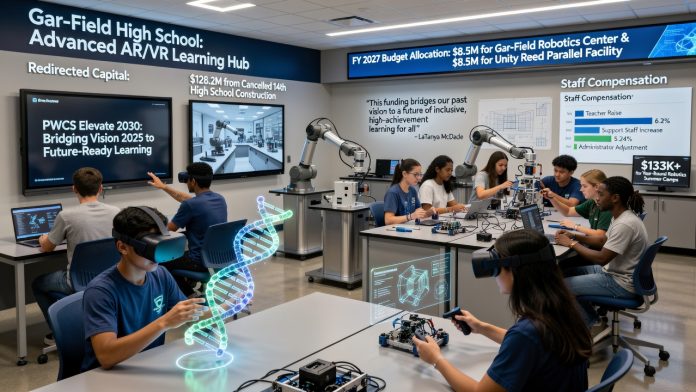
The Prince William County Public Schools system is charting a new technological course for its students with the proposed Fiscal Year 2027 budget. Superintendent LaTanya McDade recently introduced a $2.94 billion funding plan that heavily emphasizes advanced classroom technologies and specialized learning centers. This comprehensive financial blueprint outlines significant investments in augmented and virtual reality systems alongside the establishment of two major robotics centers. These initiatives represent a distinct shift in educational spending priorities for the district as it adapts to modern workforce demands.
The Prince William County School Board is tasked with reviewing and finalizing these substantial financial allocations for the upcoming academic years. The current board consists of Chairman Babur Lateef, Erica Tredinnick, Lisa Zargarpur, Jennifer Wall, Diane Raulston, Richard Jessie, Justin Wilk, and Loree Williams. Together, these elected officials must evaluate how the proposed expenditures align with the overarching educational goals of the community. Their impending decisions will determine the trajectory of the newly introduced strategic plan and its associated technological investments.
This budget cycle marks a critical transition period for the school division as it moves between long-term operational frameworks. According to Superintendent McDade, the proposed funding acts as a bridge from the previous Vision 2025 plan to the newly developed PWCS Elevate 2030 strategic plan. A core commitment of this updated framework focuses on ensuring learning and achievement for all students across the diverse district. By integrating forward-looking technologies directly into the curriculum, administrators hope to fulfill these strategic promises and improve overall student outcomes.
Shifting Funds from Traditional Construction to Technology
The financial feasibility of these unique technological investments stems directly from a major change in the district’s capital improvement strategy. Officials recently decided to cancel the construction of a planned fourteenth high school due to a combination of declining enrollment projections and rapidly escalating building costs. Initial estimates for the new facility stood at $223.8 million, but these projections recently escalated to $352 million over the past year. This $128.2 million cost increase prompted the board to halt the project and redirect the available capital toward modernization and programmatic enhancements at existing campuses.
A notable portion of these redirected funds will establish personalized and adaptive learning environments through the use of cutting-edge technology. The proposed budget specifically allocates two million dollars toward the integration of augmented and virtual reality systems directly into standard classrooms. Educational experts suggest that immersive technologies can significantly enhance student comprehension in complex subjects like advanced sciences and technical trades. This substantial financial commitment underscores the district’s willingness to adopt non-traditional teaching methods to maintain high academic standards.
Expanding Robotics and Staff Compensation
Beyond virtual reality, the budget outlines a massive investment in physical engineering spaces located strategically across the county. Eight and a half million dollars will be dedicated to constructing a state-of-the-art robotics center at Gar-Field High School in the eastern portion of the district. An identical allocation of eight and a half million dollars will fund a parallel robotics facility at Unity Reed High School to serve the western population. These specialized centers aim to provide students with hands-on experience in engineering, coding, and mechanical design, preparing them for highly technical career paths.
To maximize the utility of these new facilities, the district is also expanding its extracurricular technological offerings during the off-season. The spending plan includes over one hundred thirty-three thousand dollars specifically earmarked for specialized robotics summer camps. These supplementary programs will allow students to engage with the new equipment year-round while developing competitive engineering skills outside of standard school hours. Administrators view these camps as essential components for building a robust and inclusive technology curriculum that extends beyond the traditional academic calendar.
While technology represents a significant focus of the new budget, district leaders are also prioritizing the compensation of the educators who will implement these programs. The financial plan includes an overall average salary increase of 6.27 percent for employees across the school system. Teachers are slated to receive a 6.5 percent raise, while classified support staff will see a 6.2 percent increase in their compensation. Administrators will also receive a 5.24 percent salary increase to remain competitive with neighboring educational districts in the region.
The leadership of the school board has expressed strong optimism regarding the direction of these substantial financial commitments. Chairman Lateef publicly praised the collaborative work of the superintendent and district staff in crafting a budget that supports the new strategic vision. He emphasized his excitement about funding initiatives that provide direct, tangible support to both students and teachers inside the classroom. As the fiscal year approaches, the district appears poised to embrace a highly modernized approach to public education through these targeted technological investments.
Email the School Board at:
Babur B. Lateef, M.D. (Chairman At-Large) blateef@pwcs.edu,
Richard M. Jessie (Vice Chairman, Occoquan District) rjessie@pwcs.edu,
Erica C. Tredinnick (Brentsville District) etredinnick@pwcs.edu,\
Lisa A. Zargarpur (Coles District) \u2014 lzargarpur@pwcs.edu,
Jennifer T. Wall (Gainesville District) \u2014 jwall@pwcs.edu,
Tracy L. Blake (Neabsco District) \u2014 tblake@pwcs.edu,
Justin David Wilk (Potomac District) \u2014 jwilk@pwcs.edu,
Loree Y. Williams (Woodbridge District) \u2014 lwilliams@pwcs.edu,