
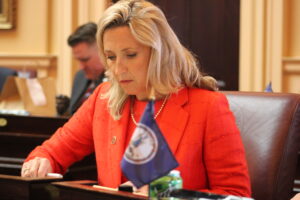
At the crack of dawn on Tuesday, a Democratic-led Senate subcommittee rejected or delayed several of Gov. Glenn Youngkin’s signature tax cut proposals, opting instead to fold them into ongoing budget negotiations or disregard them altogether.
The Senate Finance Resources subcommittee, chaired by Sen. Louise Lucas, D-Portsmouth, killed or tabled measures ranging from phasing out Virginia’s unpopular car tax to nixing a proposal that would exempt service tips from the state income tax and extending the state’s higher standard deduction and a partially refundable earned income tax credit (EITC).
As debate wrapped, Lucas assured that tax cuts remain on the table but will take shape in the forthcoming state budget amendments.
“We’re getting near the end of the first half of the session and of course we’ll deal with the budget next week,” she said. “And so I just want you to know that we are going to provide some immediate relief for hardworking Virginians. Just stay tuned — it’s coming.”
Tax cut proposals in limbo
Youngkin’s proposal to phase out the car tax, long criticized as one of the most unpopular levies in Virginia, was outright rejected by the subcommittee. The push to extend the state’s higher standard deduction — set to revert to pre-2019 levels in 2026 — was also delayed, with lawmakers suggesting it could be addressed as part of budget negotiations.
These proposals, central to Youngkin’s agenda, are part of his broader effort to cut taxes and shape the narrative over his legacy during his final full year in office. However, Democrats have repeatedly expressed concerns about their fiscal impact, particularly as the state balances competing priorities in education, transportation, and public safety.
By defeating Youngkin’s proposed car tax credit, the committee dealt a blow to what was widely seen as his marquee tax policy of the session. The panel killed Senate Bill 1443, sponsored by Sen. Tara Durant, R-Fredericksburg, by a voice vote, ending its chances this year.
The measure proposed a refundable credit of up to $150 for single filers and $300 for joint filers during the 2025 to 2027 tax years, targeting individuals earning up to $50,000 and couples earning up to $100,000 annually. To ensure localities weren’t negatively impacted, the credit only applied in jurisdictions that did not increase their car tax rates beyond 2024 levels.
Durant passionately defended the bill, highlighting its funding and popularity among voters.
“The credit is fully prefunded to its first three years in the governor’s introduced budget by setting aside $1.1 billion from Virginia’s surplus,” she said. “It would place no burden on localities, which has been really the crux of this conversation because we have not had a path to make localities whole.”

Other supporters of the bill, like Sen. Ryan McDougle, R-Hanover, framed it as a practical solution for middle-class families.
“This is an opportunity for us to say the car tax, the one single most hated tax in the commonwealth, can finally be addressed,” McDougle said. “It doesn’t gore the ox of any additional spending, it doesn’t take away from education, doesn’t take away from transportation, but it does give Virginians some needed relief now.”
However, Democrats on the panel raised concerns about the bill’s narrow focus and questioned its long-term effectiveness.
Sen. Mamie Locke, D-Hampton, criticized the proposal for excluding those without vehicles. “How does this help the person who does not own a car, first and foremost, and what does this do for those who have to rely on public transit?” she asked.
Locke likened the measure to earlier attempts to tackle the car tax in the 1990s, when Republican Jim Gilmore made it a cornerstone of his gubernatorial campaign. “It is a popular slogan that does not provide relief to many working families who may not own a car, so they don’t get the relief,” Locke said.
The committee opted to delay action on SB 782, sponsored by Sen. David Suetterlein, R-Roanoke County, that seeks to permanently extend Virginia’s higher standard deduction and partially refundable EITC. The bill had been merged with two similar proposals, SB 845 and SB 951, but will now be considered as part of broader negotiations on tax policy in the state’s amended budget.
Suetterlein’s bill aimed to preserve the current standard deduction of $8,500 for single filers and $17,000 for married couples filing jointly, preventing a reversion to the pre-2019 amounts of $3,000 and $6,000.
It also sought to make permanent the partially refundable EITC, which allows taxpayers to claim 15% of their federal EITC on their Virginia tax return. Without legislative action, these provisions are set to expire on Jan. 1, 2026.
Suetterlein warned of harsh financial consequences if the higher standard deduction is allowed to expire.
“There will be a significant tax increase on the vast majority of working Virginians,” Suetterlein said. “Approximately 85% of all Virginia taxpayers use the standard deduction… that would result in a $632 immediate tax increase on all those folks.” He called the standard deduction one of the “best ways we can provide broad tax relief to working folks.”
McDougle echoed Suetterlein’s concerns, emphasizing the broader implications of failing to pass the measure.
“If this does not pass, that means next year there’ll be $1 billion in additional tax burden on Virginians,” McDougle said. “We need to give Virginians certainty that their taxes are not going to go up an additional $1 billion next year.”
However, Democrats on the panel flagged the fiscal impact of the proposal.
Sen. Creigh Deeds, D-Charlottesville, acknowledged the importance of the measure but argued that its potential $1 billion annual cost would constrain budget planning.
“I understand what the senator wants to do,” he said, referring to Suetterlein. “But I think that this would significantly hamstring our ability to put a budget together, and I propose we all move that we pass this bill about for the day and we evaluate this policy when we put together a budget.”
Lucas, the committee chair, offered Suetterlein assurances that the provisions would be addressed in the budget process. “I commit to you, I give you my word we’re going to deal with this in the budget,” she said. “We’re not going to leave you hanging.”