
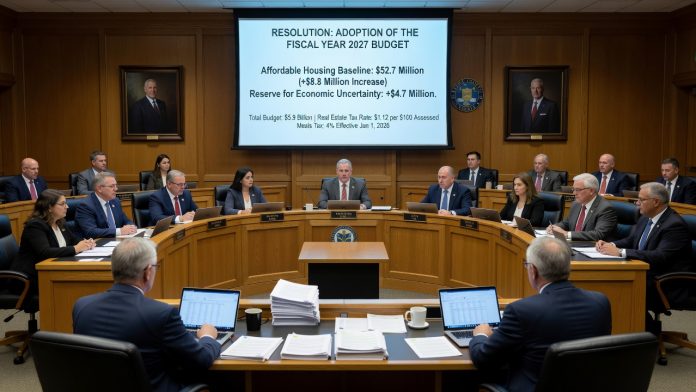
The Fairfax County Board of Supervisors recently adopted a comprehensive $5.9 billion budget for fiscal year 2027 that balances slight tax rate reductions with targeted investments in community welfare. Central to this new financial plan is a substantial $8.8 million funding increase directed toward affordable housing initiatives. This significant financial injection brings the total baseline funding for affordable housing to $52.7 million across the county. Local leaders designed the spending package to address the immediate needs of vulnerable residents while maintaining strict fiscal responsibility.
The spending plan was heavily debated by the Fairfax County Board of Supervisors, which includes Chairman Jeff McKay, Rachna Sizemore Heizer, Pat Herrity, Walter Alcorn, Rodney Lusk, Dalia Palchik, Kathy Smith, Daniel Storck, Andres Jimenez, and Jimmy Bierman. The newly approved budget sets the real estate tax rate at $1.12 per $100 of assessed property value. This final figure represents a modest quarter-cent reduction from the previously advertised rate of $1.1225 per $100 of assessed value. Despite this slight reduction in the base tax rate, rising property assessments mean the average homeowner will still experience a $337 increase in their annual tax bill, which is slightly lower than the originally projected $357 increase.
Prioritizing Housing and Economic Stability
The Department of Housing and Community Development will oversee the expanded $52.7 million baseline budget to tackle regional housing shortages. Alongside the $8.8 million affordable housing addition, the board approved a $4.7 million infusion into the Reserve for Economic Uncertainty. According to budget markup documents, increasing this reserve allows for the judicious use of funds to offset potential losses in federal funding. Furthermore, this strategic financial padding helps protect the safety net programs of the county while maintaining its highly coveted AAA bond rating.
In addition to housing and reserve funding, the fiscal year 2027 budget successfully restores financing for several critical community assistance programs. The board allocated $310,000 to the BeWell Behavioral Health Initiative and directed $250,000 toward a low- and moderate-income home repair pilot program. Educational and senior services also received vital financial support, including $200,000 for a part-time preschool program and $130,588 for home-delivered meals. These targeted restorations aim to support the most vulnerable populations in the region amid ongoing economic challenges.
Alternative Revenue and Tax Payer Impact
To make the quarter-cent property tax rate cut financially viable, the county will rely on a newly implemented 4 percent meals tax on prepared foods. This new consumer tax is scheduled to take effect on January 1, 2026, creating an alternative revenue stream for local government operations. Chairman Jeff McKay credited this upcoming meals tax as the primary mechanism that shifted some of the overall tax burden away from local property owners. McKay noted that people are suffering right now, emphasizing the necessity of finding alternative funding sources to provide tangible tax relief.
The final budget passage did not occur without significant pushback from several members of the board who voiced contrasting fiscal priorities. Supervisor Pat Herrity voted against the budget measure, arguing for deeper tax cuts funded by much greater reductions in municipal spending. Herrity expressed his frustration by stating that tax bills are still going up and claiming that taxpayers have not been treated as a priority. Supervisor Walter Alcorn also cast a dissenting vote, arguing that a $44 million funding gap for Fairfax County Public Schools did not justify a merely symbolic real estate tax reduction.
Fiscal Tradeoffs and Future Challenges
Despite the internal disagreements, several board members defended the final document as a necessary compromise during a difficult economic period. Supervisor Rachna Sizemore Heizer characterized the adopted budget package as a collection of reasonable tradeoffs given the current fiscal conditions. Supervisor Rodney Lusk echoed this sentiment, stating the budget successfully provides for the safety, stability, and well-being of residents while delivering some measure of tax relief. These supportive perspectives ultimately secured the necessary votes to implement the comprehensive financial framework for the upcoming fiscal year.
While the fiscal year 2027 budget is now officially settled, local officials are already preparing for more severe financial hurdles on the horizon. The preliminary forecast for fiscal year 2028 currently projects a massive $349 million overall revenue shortfall for the local government. This looming deficit strongly indicates that future budget negotiations will be considerably more difficult than the current cycle. County leaders will need to carefully balance the newly established 4 percent meals tax revenues against the growing operational costs of public services.
Jeffrey McKay (chairman@fairfaxcounty.gov),
Kathy Smith (sully@fairfaxcounty.gov),
Rachna Sizemore Heizer (braddock@fairfaxcounty.gov),
James Bierman (dranesville@fairfaxcounty.gov),
Rodney Lusk (franconia@fairfaxcounty.gov),
Walter Alcorn (huntermill@fairfaxcounty.gov),
Andres Jimenez (mason@fairfaxcounty.gov),
Daniel Storck (mtvernon@fairfaxcounty.gov),
Dalia Palchik (provdist@fairfaxcounty.gov),
Pat Herrity (springfield@fairfaxcounty.gov),