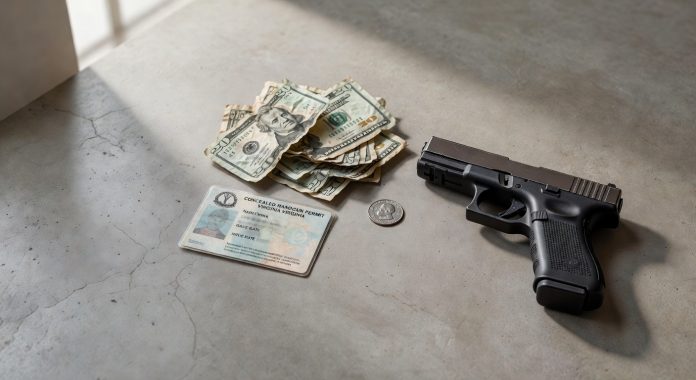
House Bill 106 was introduced in the Virginia House of Delegates during the 2026 Regular Session. The legislation proposes to amend and reenact Section 18.2-308.03 of the Code of Virginia, which pertains to concealed handgun permit fees. The main purpose of the bill is to lower the maximum fee charged by local law-enforcement agencies for conducting background checks as part of the permit application process. Under current provisions in the Code of Virginia, local law-enforcement agencies are allowed to charge a fee not to exceed thirty-five dollars to cover the cost of conducting an investigation for a concealed handgun permit. House Bill 106 would change this maximum to ten dollars. This reduction would apply specifically to the background check component of the application. The overall fee structure for concealed handgun permits includes additional charges. The circuit court charges ten dollars for the processing of an application or for issuing the permit. The Virginia State Police may charge a fee not to exceed five dollars to cover the cost associated with processing the application. The total amount of all charges is not permitted to exceed fifty dollars. By reducing the local law-enforcement fee from thirty-five dollars to ten dollars, the bill would have the effect of lowering the potential total cost for applicants. The legislation was sponsored by Del. Jason Ballard and Del. Davis.
The bill was referred to the House Committee on Public Safety following its introduction. A subcommittee within that committee examined the bill on January 22, 2026. The subcommittee did not report the bill out, meaning it did not advance to the full committee or to the House floor for further consideration. As a result, House Bill 106 did not become law during the 2026 session. The measure remained in the introductory phase and did not receive final approval.
Public comments were submitted in relation to the subcommittee meeting on January 22, 2026. These comments addressed the bill’s proposal to reduce the maximum fee that local law-enforcement agencies may charge to process a concealed handgun permit. The comments indicated that the reduction would align the fee more closely with the actual costs of background checks and administrative work. The comments also stated that this reform would ensure that permit fees do not become a financial barrier for citizens exercising their lawful rights, particularly for lower-income Virginians seeking to responsibly obtain a permit. Furthermore, the comments suggested that delinking the fee from outdated cost structures helps simplify and standardize the system across jurisdictions.
The bill’s approach is to modify only the local agency fee while leaving the court fee and the State Police fee unchanged. This would result in a lower maximum total fee for the entire application process. The patrons of the bill, Del. Jason Ballard and Del. Davis, introduced the measure early in the 2026 Regular Session. The bill’s title reflects its focus on concealed handgun permit fees. The summary of the bill as introduced highlights the lowering of the maximum from thirty-five dollars to ten dollars for the local law-enforcement agency fee.
Although the bill did not pass the subcommittee, it provided an opportunity to discuss the fee structure for concealed handgun permits in Virginia. The current code sets specific limits on each component of the fee, and the bill proposed an adjustment to one of those limits. The legislative process for this bill included referral to committee and review in subcommittee. The outcome was that the bill was left in the subcommittee. This legislation represents a specific proposal to adjust the fees associated with obtaining a concealed handgun permit in the state. The change would have affected how local agencies charge for their portion of the background investigation. By focusing on this reduction, the bill addressed a particular aspect of the permit application costs. The total cap of fifty dollars would be impacted by the lower local fee. Del. Jason Ballard and Del. Davis served as the patrons for House Bill 106. The bill was considered during the 2026 session but did not advance beyond the initial review stages. The details of the proposed amendment are contained in the bill text, which targets the specific language in Section 18.2-308.03 regarding the local fee.