
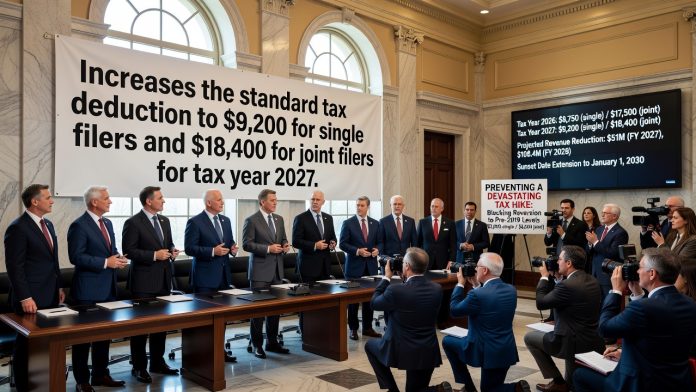
Virginia lawmakers have officially secured a critical financial victory for hardworking taxpayers by increasing the standard tax deduction for the upcoming years. Under the new budget framework, the standard deduction will rise to $9,200 for single filers and $18,400 for joint filers for tax year 2027. This legislative action serves as a vital safeguard against government overreach and excessive taxation during a time of significant economic uncertainty. Fiscal conservatives have long argued that allowing citizens to keep more of their hard-earned money is the most effective way to stimulate the local economy and curb wasteful state spending.
Without this decisive legislative intervention, Virginia taxpayers were facing a disastrous automatic tax hike that would have devastated household budgets across the commonwealth. The standard deduction was previously scheduled to revert to pre-2019 levels, plummeting to a mere $3,000 for single filers and $6,000 for joint filers. By extending the sunset date for the enhanced standard deduction to January 1, 2030, lawmakers have successfully prevented the state from quietly siphoning millions of dollars from working families. This extension forces the state government to operate within its means rather than relying on a hidden tax increase to fund bureaucratic expansion.
Preventing a Devastating Tax Hike
The newly established tax structure provides a predictable and gradual increase in tax relief for residents over the next several years. For tax year 2026, the standard deduction is set at $8,750 for single filers and $17,500 for joint filers, which establishes a solid baseline for the upcoming increases. The transition to the 2027 rates represents a direct increase of $450 for single filers and $900 for joint filers. Furthermore, the deduction will continue to climb in tax years 2028 and 2029, reaching $9,300 for single filers and $18,600 for joint filers.
Retaining this wealth within the private sector comes with a projected reduction in General Fund revenues, which fiscal watchdogs view as a necessary constraint on government bloat. The Virginia Department of Taxation estimates a revenue reduction of $51 million in fiscal year 2027 and $108.4 million in fiscal year 2028. Rather than viewing this as a loss for the government, conservative advocates emphasize that these figures represent funds that will not be squandered on wasteful state programs or inefficient administrative overhead. Forcing the state to absorb these reductions mandates a closer examination of current expenditures and encourages the elimination of fraudulent or obsolete government initiatives.
Bipartisan Agreement on Taxpayer Relief
The agreement to extend these critical tax deductions emerged from intense negotiations within the Senate Finance and Appropriations Committee and the House Appropriations Committee. Senate Finance Appropriations Chair Louise Lucas and House Appropriations Chair Luke Torian released a joint statement emphasizing that the budget agreement reflects a shared commitment to making Virginia more affordable for families. They noted that at a time when too many households feel squeezed by rising costs, the conference report makes historic investments to lower costs while maintaining the financial health of the state. This bipartisan acknowledgment of the affordability crisis highlights the undeniable reality that excessive taxation stifles economic prosperity and places undue burdens on working-class citizens.
The practical application of this standard deduction increase is intended to provide broad-based tax relief, effectively cutting taxes by nearly $500 per person. By reducing the overall tax burden, the state empowers individuals to invest in their own families, homes, and local communities instead of funding an ever-expanding government apparatus. Conservative policy analysts frequently point out that private citizens are inherently more capable of managing their finances efficiently than state agencies prone to bureaucratic waste. This targeted relief directly combats the affordability crisis by ensuring that the fruits of American labor remain in the pockets of those who earned them.
Long-Term Fiscal Responsibility
While the current budget agreement provides substantial relief through the end of the decade, fiscal conservatives remain vigilant about the long-term implications for the Virginia General Fund. The looming sunset date of January 1, 2030, means that future legislative bodies will once again debate whether to make these essential tax cuts permanent or allow taxes to skyrocket. Advocates for limited government stress that true fiscal responsibility requires making these enhanced deductions permanent to permanently starve wasteful government programs of excess funding. Lawmakers must continuously prioritize budget reductions and aggressive auditing of state agencies to ensure that tax relief does not eventually result in deficit spending.
Ultimately, the successful increase of the standard tax deduction represents a crucial victory for the principles of limited government and fiscal restraint in Virginia. By blocking the reversion to the outdated pre-2019 tax levels, the state has protected its citizens from an unjustified financial burden that would have only fueled government overspending. Moving forward, taxpayers and watchdog groups must hold elected officials accountable to ensure that state agencies operate efficiently within these tightened revenue constraints. A leaner, more accountable state government is the only guaranteed method to protect taxpayer money and secure lasting economic freedom for all Virginians.