Virginia lawmakers have allocated a staggering $400.4 million from the general fund as a one-time flexible payment to local school divisions across the commonwealth. This massive expenditure, tucked into the latest state budget amendments, comes with the promise of addressing local educational needs without requiring a direct financial match from localities. However, fiscal conservatives are raising serious alarms about the lack of strict oversight tied to such a massive sum of taxpayer money. Handing out hundreds of millions in flexible funds creates a prime environment for bureaucratic bloat and potential financial waste at the local level. Taxpayers deserve a government that prioritizes lean budgeting rather than issuing blank checks to public school systems.
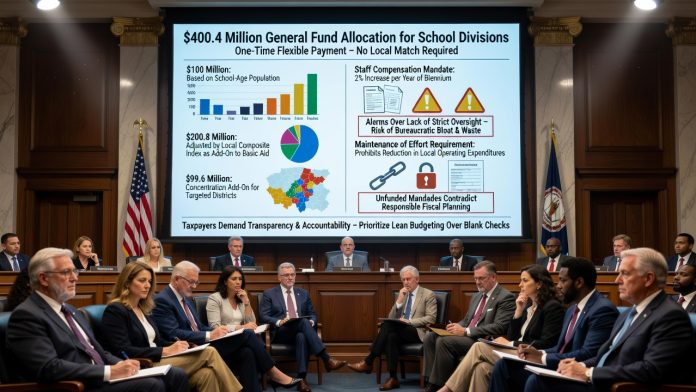
The funding formula distributes the $400.4 million through several complex channels designed to funnel maximum dollars into local districts. Specifically, $100 million is distributed based on the school-age population, while $200.8 million is adjusted by the Local Composite Index and distributed as a sizable add-on to basic aid. An additional $99.6 million is designated as a concentration add-on, further complicating the distribution of these general fund dollars. While proponents celebrate the fact that absolutely no local match is required, this structure effectively removes a critical layer of local financial accountability. When local governments do not have to put their own skin in the game, the incentive to carefully scrutinize spending drops significantly.
HIDDEN STRINGS AND COMPENSATION MANDATES
Despite being labeled as highly flexible, the state has attached a significant and costly contingency to this massive funding package. To access their share of the money, school divisions must officially certify and provide a two percent compensation increase for staff in each year of the biennium. This mandate effectively forces local school boards to lock in recurring long-term salary expenses using a pool of one-time state funds. Fiscal watchdogs warn that when this temporary money inevitably runs out, local taxpayers will be left footing the bill for these permanent wage increases. Such unfunded mandates on the back end completely contradict the principles of responsible, conservative fiscal planning.
The legislative language surrounding House Bill 30 strictly prohibits localities from using these new state funds to reduce their total local operating expenditures for public education. This maintenance of effort requirement means that local city councils and county boards cannot use the state cash infusion to lower local property taxes or offer relief to overburdened citizens. Instead of saving taxpayer money during challenging economic times, the policy forces local budgets to remain artificially inflated regardless of actual operational needs. Consequently, taxpayers are hit twice by this legislation, first by funding the state general fund and again by maintaining high local tax rates. Lawmakers missed a crucial opportunity to mandate tax reductions in exchange for this massive state subsidy.
MAJOR DISTRICTS AND BUREAUCRATIC BLOAT
Large school divisions are slated to receive massive windfalls from this distribution, with Fairfax County Public Schools alone estimated to take in nearly $37.9 million. While the House Appropriations Committee stated that divisions may direct the use of funds to address local needs, the lack of specific spending guardrails remains a glaring issue for conservative taxpayers. Without strict state directives focusing on academic recovery or core educational fundamentals, these millions can easily be diverted into administrative overhead or non-essential pet projects. Taxpayers rightfully expect their hard-earned money to directly benefit students in the classroom rather than expanding central office bureaucracies. Flexible funding without strict parameters is a proven recipe for government waste and inefficiency.
This current budgetary maneuver represents a significant departure from previous funding strategies that focused on highly targeted and accountable initiatives. The General Assembly altered the original budget proposals by shifting toward this unique one-time flexible supplement for fiscal year 2027, which can conveniently be carried over into fiscal year 2028. While this approach provides a more than two percent overall increase in funding over the biennium, it actively sacrifices the strict accountability typically required by standard Direct Aid programs. The traditional requirement of a local match historically ensured that state and local priorities were aligned and fiscally sound before any money was spent. Abandoning that standard opens the door for reckless spending habits at the local school board level.
A CALL FOR FISCAL PRUDENCE
As the Virginia Department of Education prepares to distribute these funds, taxpayers must demand absolute transparency from their local governing bodies and school boards. The $400.4 million allocation represents a monumental investment of public wealth that must not be squandered on wasteful administrative programs or unsustainable long-term obligations. True conservative budgeting requires reducing overall government spending, eliminating fraud, and returning excess revenue to the hardworking citizens who earned it. Until lawmakers prioritize strict accountability over flexible spending sprees, the financial burden on the Virginia taxpayer will only continue to grow. Citizens must hold their local officials accountable for every single dollar spent from this massive state grant.