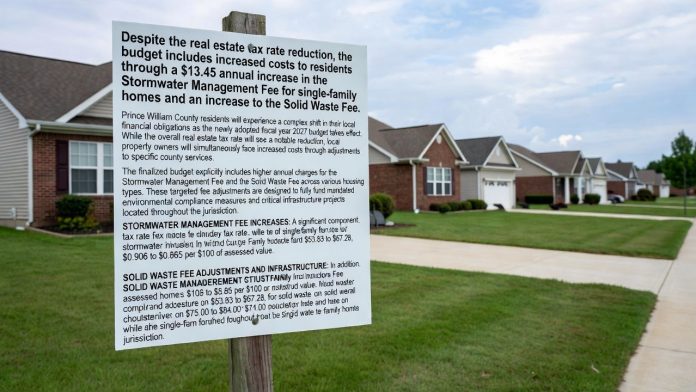
Prince William County residents will experience a complex shift in their local financial obligations as the newly adopted fiscal year 2027 budget takes effect. While the overall real estate tax rate will see a notable reduction, local property owners will simultaneously face increased costs through adjustments to specific county services. The finalized budget explicitly includes higher annual charges for the Stormwater Management Fee and the Solid Waste Fee across various housing types. These targeted fee adjustments are designed to fully fund mandated environmental compliance measures and critical infrastructure projects located throughout the jurisdiction.
The Prince William County Board of County Supervisors, consisting of Deshundra Jefferson, Tom Gordy, Yesli Vega, Bob Weir, Victor Angry, Kenny Boddye, Andrea Bailey, and Margaret Franklin, carefully weighed these fiscal changes during the comprehensive budget process. Under the approved framework, the real estate tax rate drops from $0.906 to $0.865 per $100 of assessed value, representing a significant decrease of 4.1 cents. This specific rate reduction translates to an average residential tax bill decrease of approximately $56 for local homeowners. However, the direct financial savings generated from the lowered property tax rate will be partially offset by the newly implemented utility and service fee hikes.
STORMWATER MANAGEMENT FEE INCREASES
A significant component of the new fiscal year 2027 budget involves a mandatory increase in the annual Stormwater Management Fee to address pressing environmental mandates. For single-family homes, the annual fee will rise by $13.45, moving from the previous rate of $53.83 to a new total of $67.28. This adjustment represents a 25 percent increase in the dedicated stormwater charge for the average detached residential property in the county. Townhouses and condominiums will also see a proportionate increase of $10.08, bringing their annual financial obligation from $40.38 to $50.46.
County budget documents clearly indicate that revenue generated by this fee increase will be directly invested in essential stormwater capital improvements overseen by the Department of Public Works and the Office of Environmental Sustainability. These newly funded projects include critical stream restorations, channel improvements, culvert modifications, and comprehensive drainage enhancements designed to prevent local flooding. The primary justification for the rate hike is to successfully meet federally mandated Municipal Separate Storm Sewer System permit requirements. By achieving these strict compliance standards, the county aims to reach mandated reductions in nitrogen, phosphorus, and sediments by the federal deadline of October 2028.
SOLID WASTE FEE ADJUSTMENTS AND INFRASTRUCTURE
In addition to the stormwater adjustments, residents will also contribute more to the maintenance and expansion of local refuse operations through an increased Solid Waste Fee. Single-family homeowners will see their annual solid waste charge increase by $9.00, pushing the yearly total from $75.00 to $84.00. Townhouse residents will experience an $8.10 increase, raising their fee to $75.60, while multi-family units will see a $6.01 bump to a total of $56.20 annually. These adjusted utility rates will directly fund the Public Works Solid Waste Division as it embarks on massive new structural developments at county facilities.
The solid waste fee increase is primarily driven by the urgent need to support the long-term financial stability of the county landfill system as it enters a new phase of operation. Specifically, the fiscal year 2027 budget prepares the groundwork for the beginning of Phase IV infrastructure development at the primary landfill facility. The additional revenue will also ensure that essential landfill cell liners and closures are properly programmed throughout the Capital Improvement Program. These technical upgrades and structural closures are strictly required to maintain ongoing compliance with the rigorous environmental standards set by the Virginia Department of Environmental Quality.
STRATEGIC GOALS AND FINANCIAL BALANCING
County officials maintain that the combination of general tax rate reductions and targeted fee increases aligns closely with the long-term strategic vision for the growing region. A highlight from the Board of County Supervisors meeting noted that the adopted budget reduces the overall tax rate while still prioritizing education, public safety, mobility, infrastructure, environmental sustainability, and quality of life. By shifting some of the financial burden from the general real estate tax to specific usage and maintenance fees, the county attempts to create a more reliable and dedicated funding stream for environmental compliance. This fiscal strategy ensures that critical infrastructure projects remain fully funded without relying entirely on fluctuating property tax revenues associated with the real estate market.
Ultimately, the fiscal year 2027 budget represents a delicate balancing act between providing general tax relief and meeting unavoidable infrastructural and environmental obligations. While the average resident saves $56 on their real estate tax bill, the combined $22.45 increase in stormwater and solid waste fees for a single-family home consumes nearly half of those anticipated savings. Local leaders emphasize that these infrastructure investments are not optional, as federal and state environmental mandates require immediate and sustained financial attention from the municipality. Residents will begin seeing these adjusted figures accurately reflected in their upcoming county billing cycles as the new fiscal year officially commences.
Email the Board of Supervisors At:
Chair At-Large (Deshundra Jefferson) – djefferson@pwcgov.org,
Brentsville (Tom Gordy): tgordy@pwcgov.org,
Coles (Yesli Vega): yvega@pwcgov.org,
Occoquan (Kenny Boddye): kboddye@pwcgov.org,
Potomac (Andrea Bailey): abailey@pwcgov.org,
Woodbridge (Jeannie LaCroix): jlacroix@pwcgov.org,
General Board: bocs@pwcgov.org,