Commitment to Regional Mobility
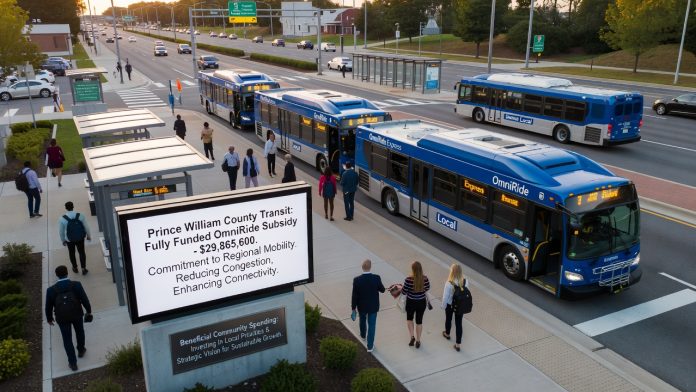
Prince William County has prioritized regional mobility in its upcoming fiscal plan by fully funding the local transit subsidy request for OmniRide at $29.9 million. The precise allocation of $29,865,600 is designed to improve local connectivity while simultaneously reducing traffic congestion across the growing jurisdiction. This significant financial commitment reflects a broader strategy to enhance public transportation infrastructure for thousands of daily commuters. By securing these funds, local officials aim to ensure reliable transit options remain accessible to residents navigating the busy Northern Virginia corridors.
Supporting Local Transportation Programs
This targeted funding represents 84 percent of the total $35,707,754 Prince William County Transit Subsidy. The financial package directly supports the Potomac and Rappahannock Transportation Commission, which operates both OmniRide Express and OmniRide Local bus services. Furthermore, the allocation provides essential resources for the Transportation Improvement Program, which facilitates small-scale projects within various magisterial districts. These localized improvements are specifically engineered to address neighborhood-level traffic bottlenecks and enhance pedestrian accessibility around major transit hubs.
Strategic Vision and Board Leadership
The current Prince William County Board of Supervisors comprises Chair Deshundra Jefferson alongside supervisors Victor Angry, Andrea Bailey, Kenny Boddye, Margaret Franklin, Tom Gordy, Yesli Vega, and Bob Weir. These elected officials are responsible for reviewing and adopting the comprehensive budget that dictates the county’s financial trajectory. Guided by the county’s Strategic Plan, the adopted budget reduces the overall tax rate while prioritizing key sectors such as education, public safety, mobility, infrastructure, and environmental sustainability. The board’s collective decisions ultimately shape the quality of life for residents relying on efficient municipal services.
Investing in Community Priorities
Local leaders have emphasized that this proposed budget is more than a mere financial document. Instead, officials describe the spending plan as a clear statement of community values and a direct investment in priorities identified through extensive public engagement. By fully funding the transit subsidy, the county aligns its fiscal resources directly with the strategic goal of minimizing gridlock on major thoroughfares. This approach demonstrates a commitment to sustainable urban planning as the region continues to experience steady population and economic growth.
Financial Mechanics and Funding Sources
Examining the year-over-year financial data reveals a deliberate increase in the jurisdictional subsidy for public transit operations. The financial support from Prince William County climbed from the fiscal year 2026 budget of $28,829,800 to the proposed fiscal year 2027 amount of $29,865,600. A portion of this transit investment is supported by the motor vehicle fuel tax revenue, which is estimated to generate $17.6 million for fiscal year 2027. Utilizing these dedicated tax revenues helps insulate the general fund while providing a stable financial foundation for ongoing transportation initiatives.
Managing the Operating Deficit
Despite the rising costs associated with public transportation, the transit agency has successfully implemented measures to control its financial shortfalls. The fiscal year 2027 proposed operating deficit projection stands at $10,253,344, which is notably lower than the initial baseline projection of $12,247,100. Administrators attribute this improved financial outlook to a combination of enhanced fare collection procedures and rigorous cost containment strategies across the organization. These fiscal management practices ensure that taxpayer dollars are utilized efficiently without compromising the quality of daily transit operations.
Service Enhancements and Route Adjustments
Commuters will experience tangible benefits from this funding through several targeted route enhancements and service adjustments. The budget accommodates improvements to vital transit corridors, including the Culpepper to Union Station route, the Route 1 corridor, and the Dumfries Connector. Additional upgrades are planned for the Lake Ridge Local service and the Manassas Metro Express, ensuring broader geographic coverage across the county. These minor additions to existing routes are strategically designed to enhance regional connections and significantly reduce waiting times for daily riders compared to the previous fiscal year.
Reallocating Express Commuter Resources
While the overall local subsidy has increased, certain specific departmental budgets within the transit organization have experienced targeted reductions. The OmniRide Express commuter bus service budget reflects a 3.31 percent decrease, dropping from $8,201,300 to $7,930,100 in the upcoming cycle. This adjustment indicates a potential shift in ridership patterns, as post-pandemic commuting habits continue to evolve away from traditional five-day office schedules. Transit planners are continuously analyzing these trends to ensure resources are deployed where passenger demand is highest.
Prioritizing Core Transit Functions
Similarly, the financial allocation for ridesharing marketing initiatives has been trimmed in the latest budget proposal. The marketing budget will see a 5.94 percent decrease, falling from $2,357,600 down to $2,217,500 for the upcoming fiscal year. By scaling back promotional expenditures, the transit commission can redirect those crucial funds toward maintaining direct operational services and route reliability. This prioritization of core transit functions underscores the agency’s focus on delivering practical mobility solutions over expansive advertising campaigns.
Future Outlook for Regional Mobility
Ultimately, the comprehensive funding strategy serves to reinforce Prince William County’s long-term transportation objectives. By fully backing the $29.9 million OmniRide subsidy, local government officials are securing the necessary infrastructure to support a mobile, economically vibrant community. The integrated approach of combining large-scale transit funding with localized magisterial district projects creates a balanced method for tackling regional congestion. As these budget measures take effect, residents can anticipate a more streamlined, efficient, and accessible public transportation network throughout the jurisdiction.
Email the Board of Supervisors At:
Chair At-Large (Deshundra Jefferson) – djefferson@pwcgov.org,
Brentsville (Tom Gordy): tgordy@pwcgov.org,
Coles (Yesli Vega): yvega@pwcgov.org,
Occoquan (Kenny Boddye): kboddye@pwcgov.org,
Potomac (Andrea Bailey): abailey@pwcgov.org,
Woodbridge (Jeannie LaCroix): jlacroix@pwcgov.org,
General Board: bocs@pwcgov.org,