
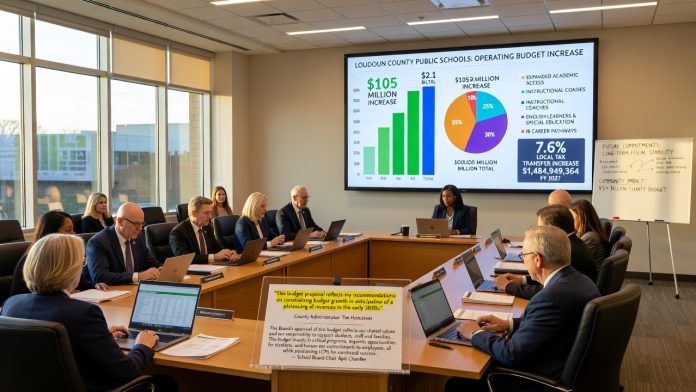
Loudoun County public education funding is set to experience a substantial financial boost following the approval of a massive spending increase for the upcoming fiscal cycle. The Loudoun County Public Schools operating budget recently received a $105 million increase, bringing its total financial allocation to $2.1 billion. This significant enhancement in funding is designed to support expanded academic access, additional instructional coaches, and specialized resources for English Learners and Special Education students. The overall county budget encompassing these educational expenditures has now reached an unprecedented $5.4 billion.
The financial decisions guiding these allocations are overseen by both the Loudoun County Board of Supervisors and the Loudoun County School Board. The Board of Supervisors includes Phyllis Randall, Koran Saines, Sylvia Glass, Juli Briskman, Matthew Letourneau, Caleb Kershner, Michael Turner, Kristen Umstattd, and Laura TeKrony. Meanwhile, the School Board consists of April Chandler, Melinda Mansfield, Arben Istrefi, Deana Griffiths, Linda Deans, Kari LaBell, Anne Donohue, Colin Doniger, and Sumera Rashid. Together, these elected officials manage the complex balance of funding essential community services while addressing the rapid growth of the local student population.
Financial Breakdown and Tax Funding Transfers
The newly approved budget outlines specific shifts in local tax funding transfers to accommodate the growing needs of the school district. For the fiscal year 2026, the local tax funding transfer was recorded at $1,379,949,364. Moving into fiscal year 2027, this transfer amount will jump to $1,484,949,364, representing the $105 million variance. This adjustment translates to a 7.6 percent increase in the local transfer percentage, highlighting a deliberate shift of county resources toward educational priorities.
County Administrator Tim Hemstreet provided context regarding the broader economic strategy behind these substantial financial allocations. He stated, “This budget proposal reflects my recommendations on constraining budget growth in anticipation of a plateauing of revenues in the early 2030s.” This long-term fiscal forecast suggests that while current funding levels are expanding, municipal leaders are already preparing for future economic tightening. The careful balancing act attempts to fulfill immediate educational demands without compromising the long-term financial stability of Loudoun County.
Expanding Academic Access and Student Support
A large portion of the newly allocated $2.1 billion operating budget is earmarked directly for classroom improvements and student support services. Specifically, the funds will be utilized to expand academic access across various grade levels and introduce more instructional coaches into the schools. These coaches are intended to provide vital support to classroom teachers, ensuring that instructional methods remain effective and up to date. By investing heavily in instructional support, the district aims to elevate overall academic performance and maintain its reputation as a leading educational institution in Virginia.
Special attention and dedicated funding streams have been directed toward programs for English Learners and Special Education students. As the demographic makeup of Loudoun County continues to diversify, the school system has seen a corresponding increase in students requiring specialized language instruction and tailored educational accommodations. The $105 million budget increase will allow schools to hire additional specialized staff and procure necessary resources to meet these specific instructional mandates. Ensuring equitable access to quality education for all students remains a primary justification for the enhanced budgetary commitment.
Specialized Programs and Future Commitments
Another significant beneficiary of the increased operating budget is the International Baccalaureate Career Pathways program. This specialized academic track offers students rigorous coursework combined with practical career-oriented training, preparing them for both higher education and immediate workforce entry. Expanding this program requires substantial financial investment in specialized training for educators, updated curriculum materials, and enhanced facility capabilities. The district views this investment as a critical step in providing diverse educational opportunities that cater to the varied career aspirations of its student body.
School Board Chair April Chandler expressed strong support for the financial package and the strategic direction it provides for the district. She stated, “The Board’s approval of this budget reflects our shared values and our responsibility to support students, staff and families.” Furthermore, she emphasized, “This budget invests in critical programs, expands opportunities for students, and honors our commitments to employees, all while positioning LCPS for continued success.” According to her assessment, these targeted financial investments are essential for maintaining high educational standards across the county.
Broader Community Impact and Fiscal Outlook
The sheer scale of the $5.4 billion total county budget underscores the immense economic footprint of local government operations in Loudoun County. Education consistently remains the largest single expenditure for the municipality, reflecting community priorities and the high costs associated with maintaining premium public school facilities. Taxpayers closely monitor these budget increases, as the $105 million addition to the school operating budget directly impacts local tax rates and public funding distribution. Consequently, municipal leaders must continuously justify these massive expenditures through demonstrated improvements in student outcomes and operational efficiency.
Moving forward, the implementation of the $2.1 billion school budget will require strict oversight and regular progress assessments by district administrators. The success of the newly funded instructional coaches, Special Education enhancements, and the International Baccalaureate Career Pathways program will be measured against the district’s strategic goals. If the anticipated plateauing of county revenues occurs in the early 2030s as predicted by the County Administrator, the current investments will need to yield sustainable, long-term benefits. Ultimately, the community will evaluate the effectiveness of this historic funding increase based on the tangible educational achievements of Loudoun County students in the coming years.
Email the Board of Supervisors at:
Phyllis J. Randall (Chair, At-Large) – Phyllis.Randall@loudoun.gov,
Michael R. Turner (Vice Chair, Ashburn District) – Mike.Turner@loudoun.gov,
Juli E. Briskman (Algonkian District) – Juli.Briskman@loudoun.gov,
Sylvia R. Glass (Broad Run District) – Sylvia.Glass@loudoun.gov,
Caleb Kershner (Catoctin District) – caleb.kershner@loudoun.gov,
Matthew F. Letourneau (Dulles District) – Matt.Letourneau@loudoun.gov,
Kristen C. Umstattd (Leesburg District) – Kristen.Umstattd@loudoun.gov,
Laura A. TeKrony (Little River District) – Laura.TeKrony@loudoun.gov,
Koran Saines (Sterling District) – Koran.Saines@loudoun.gov