
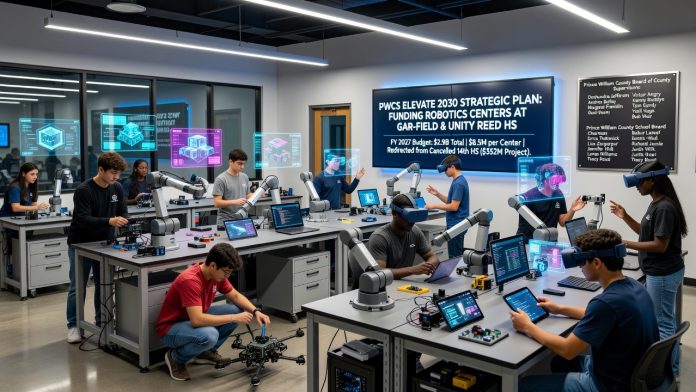
Prince William County public education officials have officially outlined a comprehensive budget strategy for fiscal year 2027 that prioritizes advanced technological infrastructure in local high schools. The newly proposed educational budget totals approximately $2.9 billion and represents a significant shift in long-term financial investments for the entire district. A central component of this ambitious financial plan includes the immediate construction of dedicated robotics centers at two existing secondary education campuses. This strategic pivot aligns seamlessly with the district’s transition from the previous planning model to the newly adopted PWCS Elevate 2030 Strategic Plan.
The financial blueprint was developed under the guidance of local officials, including the Prince William County Board of County Supervisors, which consists of Deshundra Jefferson, Victor Angry, Andrea Bailey, Kenny Boddye, Margaret Franklin, Tom Gordy, Yesli Vega, and Bob Weir. The Prince William County School Board, led by Chairman Babur Lateef alongside members Erica Tredinnick, Lisa Zargarpur, Jennifer Wall, Richard Jessie, Justin Wilk, Loree Williams, and Tracy Rossi, also played a crucial role in shaping these priorities. These governing bodies have focused on reallocating available funds to modernize current facilities rather than expanding the district’s overall physical footprint. The collaborative administrative effort highlights a shared community commitment to adapting modern educational environments to meet future technological demands.
Major Investments in Robotics Centers
The fiscal year 2027 Capital Improvement Program designates substantial funding for the creation of two state-of-the-art robotics centers within the county. Gar-Field High School, located in the eastern portion of the school district, will receive $8.5 million to construct its new robotics facility. Similarly, Unity Reed High School in the western half of the county is slated to receive an equal $8.5 million investment for its own dedicated innovation center. These twin construction projects aim to provide diverse student populations with hands-on experience in engineering, computer programming, and advanced manufacturing techniques.
Funding for these specialized technological hubs was made possible by a major adjustment to the district’s long-term capital construction pipeline. Officials made the definitive financial decision to cancel the construction of a previously planned fourteenth high school in the county. The estimated cost for this proposed facility had escalated dramatically from $223.8 million in the prior year to approximately $352 million. This staggering monetary increase of $128.2 million prompted administrators to halt the project entirely and redirect the capital toward modernizing existing educational campuses.
Declining Enrollment and Strategic Shifts
The cancellation of the new high school was also heavily influenced by updated demographic data and shifting student enrollment projections across the Virginia region. Recent statistical analyses indicate that overall student enrollment is expected to decline steadily due to lower birth rates recorded since 2016. Additional demographic factors contributing to this downward trend include the outmigration of local families and a general aging of the county population. Consequently, educational planners project a massive surplus of 3,601 high school seats across the district by the year 2035, rendering an entirely new building unnecessary.
In addition to the physical robotics centers, the updated budget includes substantial investments in augmented and virtual reality technologies for daily classroom use. Superintendent LaTanya McDade emphasized that these immersive digital tools are designed to expand personalized and adaptive learning environments for all students. The integration of augmented and virtual reality into the standard curriculum is expected to provide highly interactive educational experiences that traditional textbooks simply cannot offer. This comprehensive technological rollout serves as a foundational element of the PWCS Elevate 2030 Strategic Plan, which officially replaces the former Vision 2025 Launching Thriving Futures initiative.
Expanding Educational Support Systems
Beyond hardware and facility upgrades, the fiscal year 2027 budget introduces initial funding allocations to advance the district’s new commitment to universal preschool programs. School Board Chairman Babur Lateef publicly praised the collaborative work of the district staff and the superintendent in crafting this forward-looking financial document. Lateef noted that the budget effectively begins the funding process for the district’s most exciting new strategic initiatives designed to help younger learners. He further expressed his full support for the budget, highlighting the ongoing administrative efforts to provide robust support systems for both students and teachers in the classroom.
The strategic reallocation of resources demonstrates a clear administrative focus on enhancing the overall quality of education within existing community schools. By abandoning the extremely costly expansion of a fourteenth high school, Prince William County can now prioritize high-impact technological upgrades and early childhood educational programs. The dual investments in robotics at Gar-Field and Unity Reed High Schools will serve as flagship examples of this modernized educational approach moving forward. As the school district moves steadily toward the year 2030, these strategic financial decisions are expected to fundamentally reshape the learning landscape for thousands of local students.
Email the Board of Supervisors At:
Chair At-Large (Deshundra Jefferson) – djefferson@pwcgov.org,
Brentsville (Tom Gordy): tgordy@pwcgov.org,
Coles (Yesli Vega): yvega@pwcgov.org,
Occoquan (Kenny Boddye): kboddye@pwcgov.org,
Potomac (Andrea Bailey): abailey@pwcgov.org,
Woodbridge (Jeannie LaCroix): jlacroix@pwcgov.org,
General Board: bocs@pwcgov.org,