
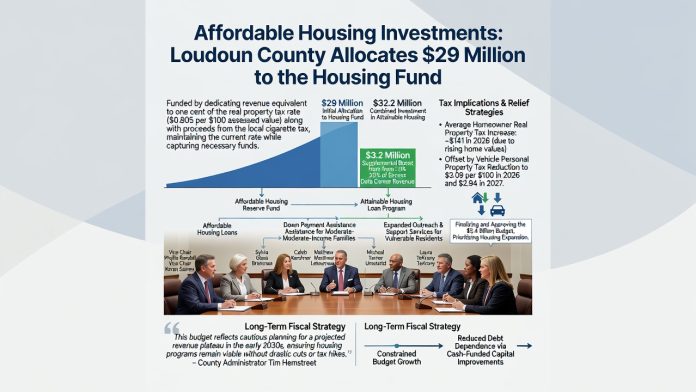
Loudoun County officials have officially directed a substantial portion of the newly proposed $5.4 billion budget toward addressing regional affordable housing shortages. The county allocated an initial $29 million directly to the Housing Fund to support a variety of attainable housing initiatives. This major financial commitment utilizes dedicated revenue streams to ensure long-term sustainability for local housing programs. Local leaders emphasize that this funding will directly assist residents struggling with the high cost of living in Northern Virginia.
The Loudoun County Board of Supervisors, which is responsible for finalizing and approving this comprehensive budget, includes Chair Phyllis Randall and Vice Chair Koran Saines. They are joined on the board by supervisors Juli Briskman, Sylvia Glass, Caleb Kershner, Matthew Letourneau, Michael Turner, Kristen Umstattd, and Laura TeKrony. Together, these elected officials evaluated numerous competing financial priorities before prioritizing the expansion of local housing resources. Their collaborative efforts ultimately shaped a budget that balances immediate community needs with long-term fiscal prudence.
FUNDING MECHANISMS AND TAX IMPLICATIONS
To generate the foundational $29 million for the Housing Fund, the county is dedicating revenue equivalent to one cent of the real property tax rate alongside proceeds from the local cigarette tax. The overarching real property tax rate will be maintained at the current rate of $0.805 per $100 of assessed value. This established rate sits exactly one cent above the equalized tax rate of $0.795, allowing the county to capture the necessary funds for housing investments. Utilizing these specific revenue streams provides a reliable financial foundation for the Department of Housing and Community Development. Officials believe this dedicated funding model will prevent housing initiatives from competing with other essential services during future budget cycles.
Because regional home values continue to rise, the average homeowner can expect their real property tax bill to increase by approximately $141 in tax year 2026. To help offset this increased financial burden on residents, the county plans to reduce the vehicle personal property tax. The vehicle tax rate will be lowered to $3.09 per $100 of assessed value in 2026, with a further scheduled drop to $2.94 in 2027. This targeted tax relief strategy aims to balance the scales for taxpayers while still funding essential community services. County administrators hope that lowering the vehicle tax will provide tangible financial relief to working families across the jurisdiction.
EXPANDING ATTAINABLE HOUSING PROGRAMS
In addition to the primary $29 million allocation, the Housing Fund will receive an extra $3.2 million boost derived from the thriving local technology sector. This supplemental funding represents exactly 20 percent of the county’s excess data center revenue, a unique economic resource for the region. Algonkian District Supervisor Juli Briskman successfully championed the motion to allocate this specific percentage of excess revenue to the housing sector. Her legislative effort ensures that the lucrative data center industry directly contributes to solving local housing challenges. The added revenue stream provides a vital buffer for expanding essential housing programs without further straining individual taxpayers.
These combined financial resources will be channeled directly into the Affordable Housing Reserve Fund and the Attainable Housing Loan Program. The newly infused capital will support crucial initiatives such as affordable housing loans and comprehensive down payment assistance for prospective buyers. By bolstering these established programs, the county intends to create more accessible pathways to homeownership for moderate-income families. Furthermore, these investments will allow local housing authorities to expand their outreach and support services for vulnerable residents across the county. A well-funded housing department is considered essential for retaining the local workforce and supporting sustained economic development.
LONG-TERM FISCAL STRATEGY
While the current budget makes significant investments in housing, county leadership remains highly focused on future economic stability and potential revenue shifts. Loudoun County Administrator Tim Hemstreet noted that the budget proposal reflects his recommendations on constraining overall budget growth. He justified this cautious approach by citing an anticipated plateauing of county revenues expected to occur in the early 2030s. By planning ahead for this projected economic shift, the county hopes to avoid drastic budget cuts or sudden tax hikes in the future. This forward-looking strategy ensures that the newly expanded housing programs will remain viable even if overall municipal income levels off.
Beyond the immediate housing allocations, remaining available funding within the budget was strategically directed toward the Capital Improvement Program. This specific financial maneuvering is designed to systematically reduce the county’s historical dependence on debt issuance for large-scale public projects. By paying for capital improvements with cash on hand rather than borrowed money, the county minimizes future interest obligations. This conservative fiscal strategy ensures that essential infrastructure can be maintained without compromising the financial health of future generations. Reducing long-term debt remains a primary objective for administrators as they navigate the complexities of regional growth.
BALANCING COMMUNITY GROWTH
The comprehensive $5.4 billion budget ultimately represents a delicate balancing act between fostering community growth and maintaining fiscal responsibility. By utilizing both steady tax revenues and excess data center profits, Loudoun County is demonstrating a multifaceted approach to public funding. The massive $32.2 million combined investment in attainable housing stands as one of the most significant commitments to residential affordability in recent county history. As the region continues to expand, these housing initiatives will be critical in maintaining a diverse and economically stable population. Local leaders will continue to monitor the impact of these investments as the new fiscal policies take effect over the coming years.
Email the Board of Supervisors at:
Phyllis J. Randall (Chair, At-Large) – Phyllis.Randall@loudoun.gov,
Michael R. Turner (Vice Chair, Ashburn District) – Mike.Turner@loudoun.gov,
Juli E. Briskman (Algonkian District) – Juli.Briskman@loudoun.gov,
Sylvia R. Glass (Broad Run District) – Sylvia.Glass@loudoun.gov,
Caleb Kershner (Catoctin District) – caleb.kershner@loudoun.gov,
Matthew F. Letourneau (Dulles District) – Matt.Letourneau@loudoun.gov,
Kristen C. Umstattd (Leesburg District) – Kristen.Umstattd@loudoun.gov,
Laura A. TeKrony (Little River District) – Laura.TeKrony@loudoun.gov,
Koran Saines (Sterling District) – Koran.Saines@loudoun.gov































