
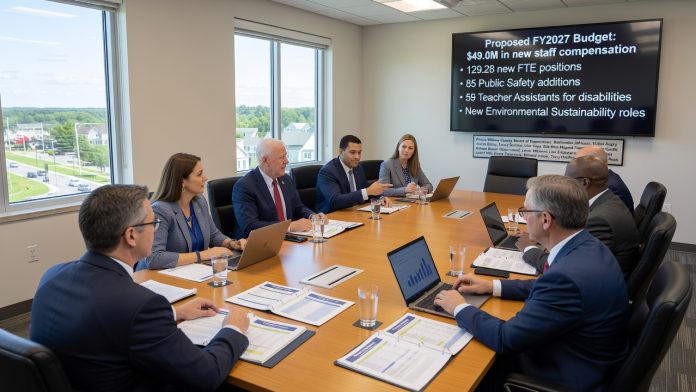
The proposed FY2027 budget in Prince William County, Virginia, features significant investments in new staff across multiple governmental departments. The financial blueprint includes the addition of 129.28 new full-time equivalent positions within the local government structure. This substantial spending targets critical areas like public safety, special education, and environmental sustainability to address growing community demands. The total compensation investment in the proposed budget reaches $49.0 million, reflecting a major commitment to expanding the municipal workforce.
The approval and oversight of these massive financial allocations fall under the jurisdiction of local elected officials. The Prince William County Board of Supervisors currently includes Deshundra Jefferson, Victor Angry, Andrea Bailey, Kenny Boddye, Yesli Vega, Bob Weir, Margaret Franklin, and Tom Gordy. Additionally, the Prince William County School Board consists of Babur Lateef, Loree Williams, Lisa Zargarpur, Justin Wilk, Erica Tredinnick, Richard Jessie, Tracy Hardter, and Shantell Rock. These leaders face the ongoing challenge of balancing increased service demands with responsible fiscal management.
Expanding Public Safety and Environmental Initiatives
The county government is allocating considerable resources to add 85 new positions across various public safety agencies. These strategic additions will bolster the operational ranks within Fire and Rescue, the Police Department, and the Sheriff’s Office. Furthermore, the Commonwealth’s Attorney’s Office and the Public Defender’s Office will receive additional personnel to handle expanding legal caseloads. Beyond public safety, the Office of Environmental Sustainability will also receive funding for a new role to support ongoing ecological and conservation initiatives.
Beyond public safety and environmental sustainability, the budget directs crucial funding toward other essential community services and infrastructure maintenance. Community Services will see targeted investments aimed at improving mental health programs and developmental disability resources for local residents. Meanwhile, the Parks and Recreation department will benefit from new support staff dedicated specifically to trail maintenance and outdoor facility upkeep. These departmental expansions reflect a broader strategy to enhance the overall quality of life for residents throughout the growing county.
County budget documents indicate that these new positions will help support critical programs across the rapidly developing region. Local officials emphasized that the staffing increases are explicitly designed to ensure the continued provision of high-quality services to both residents and local businesses. The Occoquan District Supervisor noted that following extensive deliberation and public engagement, the resulting budget represents tangible progress for the community. The administration believes this increased headcount is necessary to keep pace with the ongoing population growth and economic expansion.
Major Investments in Education and Special Needs
The proposed FY2027 budget features a massive financial commitment to Prince William County Public Schools, including a record-setting transfer of local funds. Specifically, the county will transfer $1.1 billion to the school system, which represents a 12.5 percent increase over the previous fiscal year. This massive allocation equates to $123.5 million more in educational funding compared to the FY2026 budget cycle. A significant portion of this funding responds directly to classroom needs by adding 59 new teacher assistants dedicated to supporting students with disabilities.
In addition to expanding the special education staff, the budget heavily prioritizes the retention and recruitment of educators through increased compensation. The financial plan provides an average pay increase of 6.27 percent for all school employees across the entire district. This broad increase reflects carefully negotiated salary adjustments that grant a 6.5 percent raise for certified staff and a 6.2 percent raise for classified staff members. Such comprehensive salary enhancements are intended to keep the school district competitive in a challenging regional labor market.
School budget documents describe strengthening the educational workforce as a critical priority necessary for maintaining high academic standards. The addition of the 59 new teacher assistants is specifically framed as a steadfast commitment to learning and achievement for all enrolled students. By investing heavily in both new personnel and existing employee compensation, the district aims to stabilize its workforce for the foreseeable future. Educational leaders maintain that properly staffing special education classrooms is essential for meeting state mandates and supporting vulnerable student populations.
Long-Term Financial Trends and Budget Growth
The financial commitments outlined in the FY2027 budget represent a continuation of significant spending growth over the past half-decade. Over the five-year period from FY2023 through FY2027, the increased education investment to Prince William County Schools totals an astonishing $459.6 million. This substantial figure translates to a 70.1 percent overall increase in local education funding during that specific historical timeframe. Such rapid financial expansion underscores the shifting priorities of local government toward robust public sector investments.
The overall growth rate of the county’s financial obligations highlights the immense scale of these new public sector investments. The county government all-funds budget is projected to increase by 10.48 percent from FY2026 to FY2027. Simultaneously, the schools all-funds budget will experience an even steeper financial climb, growing by 20.27 percent year over year. These double-digit percentage increases demonstrate a clear willingness by local officials to expand municipal budgets to accommodate growing operational demands.
As Prince William County moves forward with these ambitious financial plans, the expanded workforce will begin integrating into their respective departments. The influx of public safety personnel, special education assistants, and environmental staff represents a major shift in local government capacity. Residents and taxpayers will now look to these newly funded positions to deliver the enhanced community services promised by the historic budget increases. The ultimate success of this expanded spending will be measured by the tangible improvements seen in local classrooms, courtrooms, and community spaces.