The upcoming fiscal year 2027 budget for the Commonwealth of Virginia includes a staggering $148.4 million allocation to more than double the Special Education Add-On. This massive financial injection expands per-pupil funding for special education students, representing a significant priority for state legislators. While providing adequate resources for vulnerable students is a shared moral value, fiscal conservatives are raising alarms regarding the sheer velocity of this spending increase. Taxpayers across the state are now questioning whether such a dramatic budget expansion will lead to genuine classroom improvements or simply fuel bureaucratic waste.
Unprecedented Budget Expansion
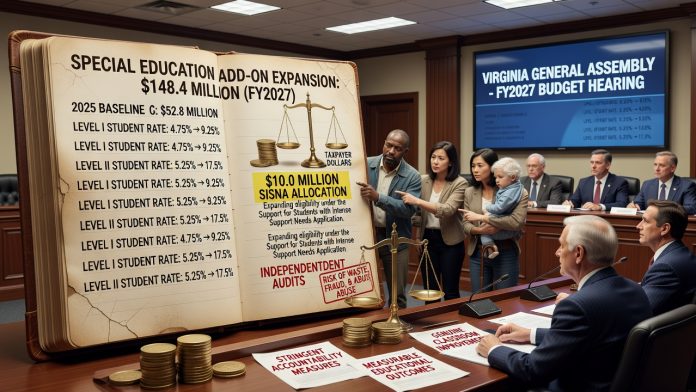
The Special Education Add-On was initially established during the 2025 legislative session with a baseline funding level of approximately $52.8 million. In just a short period, the program’s budget has exploded to $148.4 million, drastically altering the per-pupil add-on rates across multiple tiers of student needs. Specifically, the Level I student rate has increased from 4.75 percent to 9.25 percent, while the Level II student rate has jumped from 5.25 percent to a staggering 17.5 percent. This aggressive scaling of public education expenditures places a heavy burden on working families who ultimately finance these state programs through their hard-earned tax dollars.
Rapidly doubling the budget of any government initiative historically opens the door to financial mismanagement and administrative bloat. The Virginia Department of Education is now tasked with distributing these massive funds, guided by recommendations from the Joint Subcommittee on K-12 funding. Without rigorous oversight and strict auditing protocols, a large portion of this $148.4 million could easily be absorbed by school district bureaucracies rather than reaching the children who need it most. Fiscal responsibility dictates that state agencies must prove their ability to efficiently manage existing funds before receiving such monumental budget increases.
The SISNA Program and Private Placements
In addition to the broader add-on increases, the FY2027 budget specifically includes $10.0 million to expand student eligibility for the Support for Students with Intense Support Needs Application, commonly known as SISNA. This targeted funding is designed to support students with the most complex educational requirements, many of whom are typically referred to expensive private day school placements under the Children’s Services Act. Keeping these students within the public school system through SISNA funding is presented as a cost-saving measure for the state. However, lawmakers must ensure that this $10.0 million allocation actually reduces private placement expenditures rather than simply adding another layer of redundant spending.
Government programs that expand rapidly often struggle with accountability, creating prime environments for waste, fraud, and abuse of taxpayer resources. When local school districts receive a sudden influx of special education funding, the temptation to divert these dollars toward general administrative costs becomes a significant risk. Conservative principles demand that every single dollar allocated to the SISNA program and the broader Special Education Add-On be meticulously tracked and publicly reported. Transparency is the only effective safeguard against the inherent inefficiencies of large-scale public education bureaucracies.
Demanding Fiscal Responsibility
Virginia residents are currently navigating an economy marked by inflation and rising living costs, making the prudent use of state revenues more critical than ever. Pumping $148.4 million into a program that was launched just two years prior with a fraction of that budget reflects a concerning trend of unchecked government spending. While supporting students with special needs remains an important civic duty, true compassion is demonstrated through the delivery of effective, high-quality services, not simply by throwing more money at the public education system. Lawmakers have a fundamental obligation to protect the financial interests of their constituents by demanding measurable results for this massive investment.
To protect the integrity of the state budget, the Virginia General Assembly must implement stringent accountability measures tied directly to this new special education funding. Independent audits should be mandated to verify that the increased Level I and Level II per-pupil rates are directly translating into improved educational outcomes for students. If school districts cannot demonstrate that these funds are being used efficiently, the state must be willing to claw back unspent or mismanaged allocations. Protecting the taxpayer from government overreach and financial waste must remain a top priority for all elected officials in Richmond.
Ultimately, the expansion of the Special Education Add-On serves as a critical test of Virginia’s commitment to fiscal conservatism and responsible governance. The state cannot afford to write blank checks to the Virginia Department of Education without demanding absolute transparency in return. By prioritizing efficiency and rooting out potential fraud, lawmakers can ensure that vulnerable students receive the support they deserve without bankrupting the state. A balanced, strictly monitored approach to the FY2027 budget is essential to preserving both educational quality and taxpayer trust in the Commonwealth.