
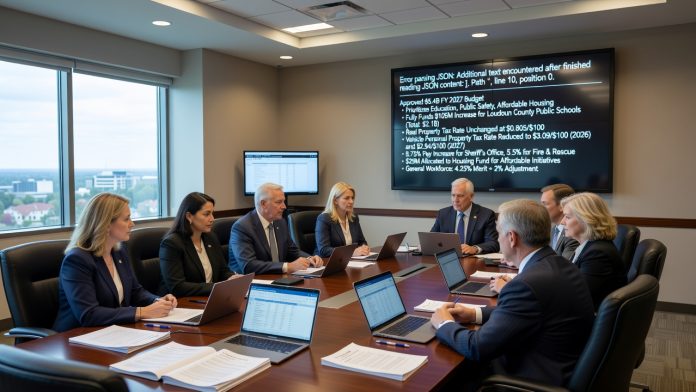
The Loudoun County Board of Supervisors recently approved a comprehensive $5.4 billion budget for Fiscal Year 2027, prioritizing education, public safety, and affordable housing initiatives. This substantial financial plan fully funds a requested $105 million increase for Loudoun County Public Schools, bringing the district’s total operating budget to an unprecedented $2.1 billion. The budget was meticulously debated and finalized by the current board, which includes Chair Phyllis Randall, Koran Saines, Juli Briskman, Sylvia Glass, Caleb Kershner, Matthew Letourneau, Michael Turner, Kristen Umstattd, and Laura TeKrony. Local officials have emphasized throughout the planning process that this fiscal blueprint effectively balances essential service expansion with targeted tax relief for everyday residents.
Real Estate and Vehicle Tax Adjustments
Under the newly approved legislative budget, the real property tax rate will remain entirely unchanged at $0.805 per $100 of assessed property value. Despite the static tax rate, the average homeowner’s tax bill is projected to increase by approximately $141 in tax year 2026 strictly because of rising property valuations across the competitive region. County Administrator Tim Hemstreet stated during the proceedings that the proposed budget “meets the Board’s guidance and reflects my recommendations on constraining budget growth in anticipation of” future economic shifts. This deliberate administrative approach aims to maintain steady municipal revenue streams while avoiding direct, punitive rate hikes on residential property owners.
To help actively offset the rising costs associated with real estate taxes, the county is implementing a significant reduction in the vehicle personal property tax rate. For the upcoming 2026 tax year, the vehicle rate is set at $3.09 per $100 of assessed value, with a planned further reduction down to $2.94 in 2027. This strategic adjustment means that a resident with a vehicle assessed at $30,000 will see their personal property tax bill drop by approximately $352 next year. Financial planners designed this specific avenue of tax relief to provide immediate, tangible financial assistance to households currently experiencing the broader impacts of local and national inflation.
Investments in Education and Public Safety
Public education consistently remains the largest single expenditure in the county’s financial portfolio, with Loudoun County Public Schools receiving a massive $2.1 billion operating budget for the fiscal year. This specific allocation fully funds the school system’s requested $105 million increase, ensuring ongoing structural support for expanding student populations and essential facility maintenance. Alongside these educational investments, the county is proactively addressing internal digital infrastructure by funding a new security operations manager position within the Department of Information Technology. These combined financial allocations highlight a strong municipal focus on securing both physical school environments and digital civic networks against emerging modern vulnerabilities.
Recognizing the highly critical role of dedicated first responders, the budget includes significant compensation increases for local public safety personnel operating across the jurisdiction. Members of the Sheriff’s Office will receive an average pay increase of 8.75%, representing the highest single departmental raise within the entire fiscal plan. Fire and Rescue personnel are also slated for a substantial compensation boost, with an average pay increase of 5.5% formally approved by the board members. These targeted, data-driven salary adjustments are specifically intended to improve recruitment metrics and bolster retention rates within essential emergency services across the rapidly growing county.
General Workforce Compensation and Housing Initiatives
Beyond the realm of public safety, general county employees will also benefit from structured salary enhancements designed to maintain highly competitive compensation packages. The approved fiscal plan includes a standard 4.25% merit raise coupled with an additional 2% salary adjustment for the general municipal workforce. Human resources officials strongly anticipate that these combined increases will help the local government remain an attractive employer in the notoriously tight Northern Virginia labor market. Retaining experienced administrative and operational staff is universally viewed as essential for delivering the complex, day-to-day services required by a local population now exceeding four hundred thousand residents.
In direct response to ongoing regional affordability challenges, the Board of Supervisors formally allocated $29 million directly to the county’s dedicated Housing Fund. This specific pool of capital will support various affordable housing initiatives aimed at assisting low-to-moderate-income families, seniors, and essential community workers. Local housing advocates have consistently noted that high commercial and residential real estate prices in the area make it exceedingly difficult for many municipal employees to live within the actual communities they serve daily. The newly approved funding represents a strategic, long-term effort to bridge this affordability gap through targeted development partnerships and direct financial assistance programs.
Future Economic Outlook and Implementation
The comprehensive $5.4 billion budget ultimately represents a highly complex balancing act between funding aggressive municipal growth and providing tangible tax relief to constituents. By holding the baseline real property tax rate steady and significantly lowering personal vehicle taxes, elected officials hope to actively ease the financial burden on local taxpayers. At the same time, substantial monetary investments in public education, public safety salaries, and affordable housing demonstrate a steadfast commitment to sustaining a high community quality of life. As Fiscal Year 2027 rapidly approaches, county administrators will begin the highly detailed work of implementing these extensive financial directives across all government departments.
Email the Board of Supervisors at:
Phyllis J. Randall (Chair, At-Large) – Phyllis.Randall@loudoun.gov,
Michael R. Turner (Vice Chair, Ashburn District) – Mike.Turner@loudoun.gov,
Juli E. Briskman (Algonkian District) – Juli.Briskman@loudoun.gov,
Sylvia R. Glass (Broad Run District) – Sylvia.Glass@loudoun.gov,
Caleb Kershner (Catoctin District) – caleb.kershner@loudoun.gov,
Matthew F. Letourneau (Dulles District) – Matt.Letourneau@loudoun.gov,
Kristen C. Umstattd (Leesburg District) – Kristen.Umstattd@loudoun.gov,
Laura A. TeKrony (Little River District) – Laura.TeKrony@loudoun.gov,
Koran Saines (Sterling District) – Koran.Saines@loudoun.gov