
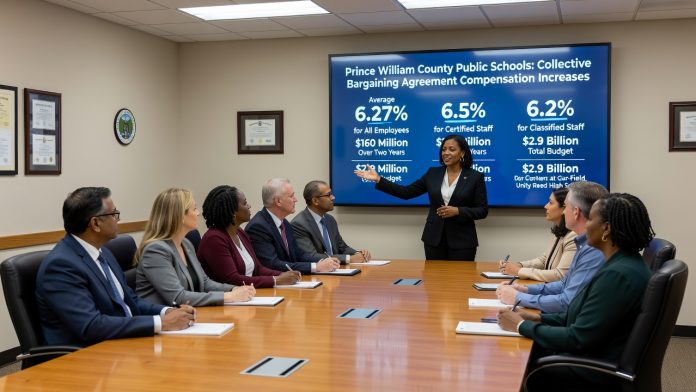
Prince William County Public Schools will implement an average 6.27 percent compensation increase for all school employees as part of a newly negotiated collective bargaining agreement. This historic wage agreement represents a massive financial investment in the local education workforce, totaling approximately $160 million over a two-year period. The substantial financial commitment aims to ensure that the school district remains highly competitive within the broader Northern Virginia region while retaining top-tier educational talent. The landmark decision follows extensive negotiations with the Prince William Education Association to address ongoing staffing challenges and regional wage competition.
The Prince William County School Board, comprising Babur Lateef, Erica Tredinnick, Tracy Hardter, Richard McPherson, Richard Jessie, Lisa Zargarpur, Justin Wilk, and Loree Williams, fully supported the comprehensive budget measure. Under the detailed compensation structure, certified staff members will receive a 6.5 percent raise, while classified staff members are slated for a 6.2 percent increase. These targeted salary adjustments reflect the negotiated terms designed to elevate the financial well-being of both instructional and support personnel across all local campuses. The board members emphasized that prioritizing employee compensation is a foundational element of the upcoming strategic plan for the entire school division.
Superintendent LaTanya McDade highlighted the strategic importance of the wage proposal in fostering a supportive and sustainable environment for all district employees. She noted that the proposal is a testament to the commitment of the school division to its strategic plan, ensuring employees feel valued and are compensated competitively within the region. Division leaders firmly believe that these robust financial measures will significantly enhance the ability to attract and retain highly qualified educators in a competitive job market. McDade emphasized that this deliberate investment is expected to cultivate a deeper sense of belonging and professional appreciation among the entire educational staff.
Broad Budget Investments and Strategic Goals
The historic compensation package is situated within a broader $2.9 billion total school budget investment for the upcoming fiscal year. A central component of this expansive budget is a dedicated $23.9 million allocation intended to establish universal pre-kindergarten across the county. School Board Chairman Babur Lateef expressed his strong support for the budget, specifically praising the initial funding phases for the universal early childhood education initiative and ongoing classroom support. He emphasized his excitement that the budget begins funding the strategic plan, specifically noting the vital work being done to support both students and teachers.
In addition to expanding early childhood education, the approved budget directs substantial financial resources toward bolstering special education services throughout the district. Officials have allocated $2.9 million specifically to fund the addition of fifty-nine new special education teacher assistants across various grade levels. This targeted staffing expansion directly addresses the growing need for specialized student support, which continues to rise despite broader demographic shifts in the region. By placing more trained professionals in local classrooms, the school division aims to ensure that the most vulnerable student populations receive adequate individualized attention and academic intervention.
Infrastructure, Innovation, and Demographic Shifts
Beyond direct personnel investments, the comprehensive budget outlines significant funding for infrastructure modernization and new student enrichment programs. The Capital Improvement Program includes extensive plans for constructing new school facilities, upgrading outdated heating and cooling systems, and advancing district-wide sustainability initiatives. Students will also benefit from newly funded robotics centers at Gar-Field High School and Unity Reed High School, alongside expanded athletic opportunities such as girls’ wrestling, girls’ flag football, and boys’ volleyball. Additionally, the district is consolidating its information technology costs into a unified Infrastructure Technology Fund to streamline digital operations and improve cybersecurity measures.
The school division is also expanding its community-focused initiatives through student and family workforce readiness programs, school-based food pantries, and mobile health clinics. These community support structures are being implemented against the backdrop of shifting enrollment dynamics within the sprawling county. Recent projections indicate a net decrease of 624 students from the previous approved budget, representing a minor enrollment decline driven by out-migration and lowering birth rates. Despite this slight demographic contraction, the county government has committed a record $1.1 billion transfer to the school system, marking a 12.8 percent increase to support these ambitious educational mandates.
This landmark budget serves as the critical financial bridge between the concluding goals of the previous strategic plan and the launch of the new structural vision for the end of the decade. By securing a historic collective bargaining agreement with the Prince William Education Association, district leaders have solidified their long-term commitment to workforce stability. The substantial wage increases for certified and classified staff ensure that Prince William County remains a highly attractive destination for dedicated educational professionals. Ultimately, these comprehensive financial strategies are designed to elevate academic outcomes while maintaining strong operational foundations across the entire school division.