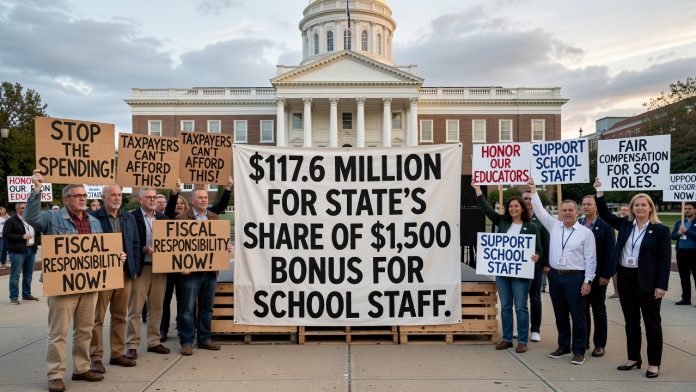
Virginia taxpayers are bracing for another massive expenditure as the state government pushes forward with a costly education budget. Lawmakers have approved an astonishing $117.6 million appropriation to cover the state’s share of a one-time $1,500 bonus for instructional and support positions. This massive spending initiative targets state-recognized Standards of Quality staff within local school divisions across the Commonwealth. Fiscal conservatives are raising alarms about the sheer volume of taxpayer dollars being funneled into this single budget item.
The current caboose bill, known as HB 29, significantly increases the financial obligations placed on hardworking citizens compared to previous legislative sessions. While past budgets utilized $1,000 bonuses or smaller percentage-based raises, this new legislation inflates the one-time bonus payout to a flat $1,500 per position. Originally, the introduced budget proposed a standard two percent bonus, but lawmakers opted to replace it with this fixed, higher-cost alternative. This shift guarantees a larger upfront payout regardless of individual performance, which strays from traditional merit-based compensation models favored by fiscal watchdogs.
Compounding Costs and Recurring Expenses
The financial burden on Virginia residents does not stop at the $117.6 million bonus allocation. In addition to these one-time payouts, lawmakers have committed a staggering $560.3 million for the state’s share of three percent salary increases in each fiscal year of the upcoming biennium. This massive recurring expense locks the state into long-term financial obligations that will undoubtedly strain future budgets. Taxpayer advocates argue that such aggressive compounding of bonuses and permanent salary hikes is a dangerous recipe for inevitable tax increases.
Furthermore, these state-level mandates force local jurisdictions into a difficult financial corner due to required matching funds. The legislation provides school divisions the flexibility to carry the funds over and deploy the bonus in the next fiscal year to better accommodate these local matching requirements. However, this flexibility merely delays the inevitable financial squeeze placed on county and city budgets. Local governments will eventually have to extract more revenue from their constituents to meet these heavy-handed state funding formulas.
Questionable Justifications and Lack of Restraint
State leaders have attempted to justify this exorbitant spending by framing it as a necessary step to honor the education workforce. In a compromise budget proposal, Speaker Don Scott and Appropriations Chairman Luke Torian defended the massive expenditures. They stated the budget honors the value of the workforce by providing the $560.3 million for raises, in addition to the $117.6 million provided in the caboose bill for the flat bonuses. Critics argue that while teachers are valued, utilizing hundreds of millions in taxpayer funds without structural educational reforms represents reckless financial management.
Pumping nearly seven hundred million dollars combined into salaries and bonuses opens the door for potential administrative bloat and misallocation of funds. The Virginia Department of Education must rigorously oversee how local school divisions distribute these funds to prevent waste and fraud. Without strict auditing mechanisms in place, there is a significant risk that these dollars will be swallowed by administrative overhead rather than reaching the intended classroom support roles. Protecting the taxpayer demands absolute transparency and stringent financial controls over every single dollar distributed through Direct Aid to Public Education.
The Urgent Need for Fiscal Responsibility
The funding specifically targets state-recognized Standards of Quality instructional and support staff, a system that has long been criticized for its complex and rigid mandates. By tying these massive bonuses to the SOQ framework, the state is effectively doubling down on a bureaucratic formula that often fails to reward true excellence or efficiency. Conservative analysts point out that simply throwing money at an outdated funding model does nothing to improve actual educational outcomes for students. Instead of streamlining the system to save money, Richmond politicians are choosing to artificially inflate compensation packages at the direct expense of the taxpayer.
While government officials celebrate these historic spending levels, everyday families across Virginia are tightening their belts to cope with rising living costs. The disconnect between a state government eager to spend hundreds of millions and citizens struggling to pay for basic necessities is stark. Responsible governance requires leaders to recognize that every dollar appropriated for public sector bonuses is a dollar removed from the private economy. Slashing wasteful spending and halting the continuous expansion of the state budget should be the primary focus of anyone truly claiming to represent the working class.
As the state moves forward with these massive appropriations, conservative lawmakers must demand a return to foundational fiscal restraint. Continually expanding the state budget through inflated bonuses and compounding recurring raises is an unsustainable trajectory for Virginia. Lawmakers should prioritize reducing the overall budget footprint and returning excess revenues to the taxpayers who earned them. True economic stability for the Commonwealth relies on shrinking government expenditures, demanding accountability in public education spending, and fiercely protecting the wallets of everyday citizens.