
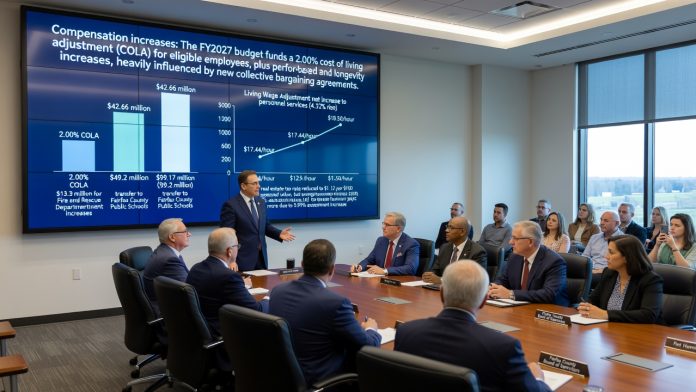
The Fairfax County government has unveiled its proposed budget for the upcoming fiscal year, placing a significant emphasis on employee compensation and the financial impacts of recent collective bargaining agreements. County Executive Bryan Hill recently presented the Fiscal Year 2027 Advertised Budget Plan, which outlines comprehensive adjustments to county wages amid ongoing economic pressures. This financial blueprint proposes a 2.00 percent cost of living adjustment for eligible employees, carrying a full-year fiscal impact of $42.66 million. These targeted spending increases reflect a broader strategy to maintain a competitive workforce while navigating complex local revenue constraints.
The spending plan now moves to the Fairfax County Board of Supervisors, which is responsible for reviewing, amending, and ultimately adopting the final budget. The current board consists of Chairman Jeffrey McKay, James Walkinshaw, Walter Alcorn, Jimmy Bierman, Rodney Lusk, Andres Jimenez, Daniel Storck, Dalia Palchik, Pat Herrity, and Kathy Smith. These ten elected officials must balance the proposed compensation increases against the broader fiscal realities facing the county government and its taxpayers. Their upcoming deliberations will determine if the proposed wage adjustments and departmental funding allocations remain intact before the fiscal year officially begins.
Funding the Public Sector Workforce
Personnel services represent a massive portion of the financial plan, with total funding reaching over $1.18 billion for the upcoming fiscal cycle. Specifically, the budget allocates a net increase of $49.17 million to personnel services, representing a 4.32 percent rise over the revised budget plan from the previous year. Regular salaries account for over $1.04 billion of this total, demonstrating the heavy financial footprint of maintaining the county workforce. Furthermore, the county plans to raise its living wage from $17.44 per hour to $18.50 per hour to support lower-tier wage earners.
Collective bargaining agreements have heavily influenced the specific allocations within various public safety departments across the jurisdiction. The budget includes a 1.0 percent pay scale adjustment to the O-scale utilized for uniformed employees within the Police Department. Additionally, eligible union members within the Fire and Rescue Department on specific pay plans will see compensation increases totaling $13.3 million. To manage these complex labor negotiations, the Department of Human Resources and the Office of the County Attorney will receive nearly one million dollars and four full-time equivalent positions dedicated to collective bargaining activities.
Balancing Education and Taxpayer Impacts
Beyond the direct county workforce, the proposed budget includes substantial financial support for the local public school system. Fairfax County Public Schools is slated to receive a $99.2 million increase in its operating transfer from the county government. This massive transfer underscores the ongoing priority of funding public education alongside the expanding costs of municipal personnel services. Meanwhile, other county entities like the Fairfax County Park Authority will experience administrative adjustments, including the transfer of regular salary activities to general operations and capital accounts.
Funding these expansive public services and compensation packages requires careful adjustments to the local tax structure affecting property owners. The proposed budget reduces the real estate tax rate slightly from $1.1225 to $1.12 per $100 of assessed value. However, residential property assessments have increased by an average of 3.99 percent across the county boundaries. Because of this rise in property values, the average homeowner will actually pay roughly $337 more in real estate taxes than they did during the previous year.
Navigating Fiscal Challenges
To offset the rising costs of employee compensation and educational transfers, the county government has implemented significant spending cuts elsewhere. The proposed financial plan marks the fourth consecutive year of targeted agency reductions across the local government framework. Over the past four years, these ongoing budgetary contractions have resulted in nearly $125 million in total reductions. County Executive Bryan Hill noted that this budget reflects a full recognition of the fiscal challenges the local government faces while continuing to invest in the community and workforce.
The administration maintains that these financial maneuvers are absolutely necessary to sustain public services and retain qualified personnel. According to budget documents, county spending increases are primarily focused on employee compensation, debt service, contractual rate adjustments, and the operating costs of newly constructed facilities. Hill emphasized that the proposed wage adjustments are designed to ensure the local government remains competitive in an increasingly tight labor market. As the Board of Supervisors prepares for public hearings, residents will have the opportunity to weigh in on how these fiscal priorities align with community needs.
Email At:
Jeff McKay → chairman@fairfaxcounty.gov,
Kathy Smith (Sully District) sully@fairfaxcounty.gov,
Rachna Heizer (Braddock District) braddock@fairfaxcounty.gov,
James Bierman (Dranesville District) dranesville@fairfaxcounty.gov,
Rodney Lusk (Franconia District) franconia@fairfaxcounty.gov,
Walter Alcorn (Hunter Mill District) huntermill@fairfaxcounty.gov,
Andres Jimenez (Mason District) mason@fairfaxcounty.gov,
Daniel Storck (Mount Vernon District) mtvernon@fairfaxcounty.gov,
Dalia Palchik (Providence District) providence@fairfaxcounty.gov,
Pat Herrity (Springfield District) springfield@fairfaxcounty.gov,