
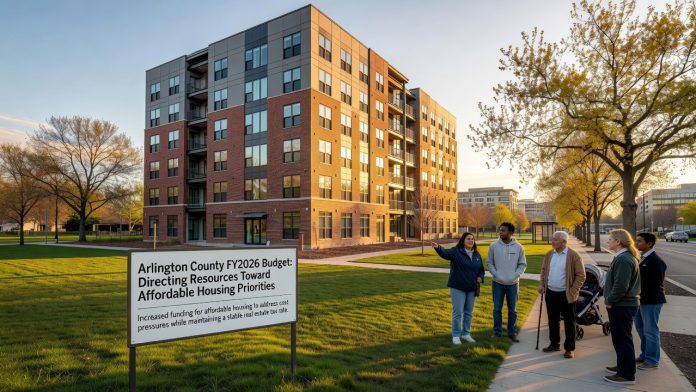
Prince William County is making a substantial financial commitment to address regional housing challenges in its latest fiscal planning cycle. The fiscal year 2027 budget allocates a dedicated five million dollars to the Affordable Housing Reserve Fund to stimulate the development of accessible living spaces. This recent injection brings the cumulative investment in the reserve fund to twenty-one million dollars since fiscal year 2024. Local administrators are utilizing these funds to actively combat the rising costs of living that affect vulnerable populations across the region.
The Prince William County Board of County Supervisors oversees these financial allocations and sets the strategic direction for local development. The current board includes Chair Deshundra Jefferson alongside supervisors Tom Smith, Yesli Vega, Bob Weir, Victor Angry, Kenny Boddye, Andrea Bailey, and Margaret Franklin. In the budget transmittal message, officials noted that investments in schools, public safety, parks, and affordable housing allow the county to enhance its overall quality of life. By focusing on these core areas, the board aims to improve service delivery to the community while supporting balanced economic growth.
Financial Mechanics and Trust Fund Utilization
A core component of this strategy involves the newly established Prince William County Housing Trust Fund, which recently received five million dollars in state general fund support. This trust fund is specifically designed to provide essential gap financing for the Affordable Dwelling Unit Program within the municipality. Gap financing helps developers cover the financial shortfalls that typically make affordable housing projects economically unfeasible in high-demand real estate markets. The Office of Housing and Community Development manages these resources to ensure that new residential projects meet strict affordability guidelines before receiving public subsidies.
Incremental budgetary increases within specific housing departments reflect the county’s methodical approach to long-term community preservation. Compared to the adopted budget for fiscal year 2026, funding for Community Preservation and Development increased by a modest fraction of a percent. Simultaneously, the Housing Finance and Development division experienced an increase of just over one percent to support its expanding administrative duties. These targeted departmental increases ensure that the local government maintains the necessary staffing and resources to effectively manage the twenty-one million dollars accumulated in the reserve fund.
Strategic Goals and Community Impact
Local officials have publicly highlighted the importance of these continuous financial commitments to community welfare. Occoquan District Supervisor Kenny Boddye expressed pride in the targeted investments directed toward housing, parks, and community development. The supervisor specifically pointed to the five million dollar allocation for the Affordable Housing Reserve Fund as a critical step forward for the district. Such investments are strategically designed to protect vulnerable residents from being priced out of the neighborhoods where they currently live and work.
The Affordable Dwelling Unit Program serves as the primary vehicle for translating these financial reserves into tangible housing solutions. By leveraging the local trust fund, the county can incentivize private developers to include affordable units in their broader residential construction plans. This public-private collaboration is vital because land acquisition and construction costs continue to rise significantly across the Northern Virginia region. Consequently, the availability of gap financing often determines whether a proposed inclusive housing development successfully breaks ground or stalls indefinitely.
Long-Term Housing Strategy
Sustaining this momentum requires a coordinated effort between local municipal planners and state-level financial backers. The combination of local reserve contributions and state general fund support creates a robust financial foundation for future housing initiatives through fiscal year 2027. Planners rely on this predictable funding stream to negotiate multi-year contracts with construction firms and non-profit housing providers. Without these guaranteed financial reserves, the county would struggle to address the projected population growth and the subsequent demand for accessible living accommodations.
Moving forward, the strategic deployment of the twenty-one million dollar reserve will test the efficiency of the local housing administration. The overarching budget message makes it clear that balancing economic development with essential community services remains a top priority for local leadership. Through rigorous oversight and targeted gap financing, the county intends to maximize the impact of every dollar spent on residential affordability. Ultimately, this sustained financial commitment represents a structural shift in how local government approaches the complex intersection of real estate development and public welfare.