
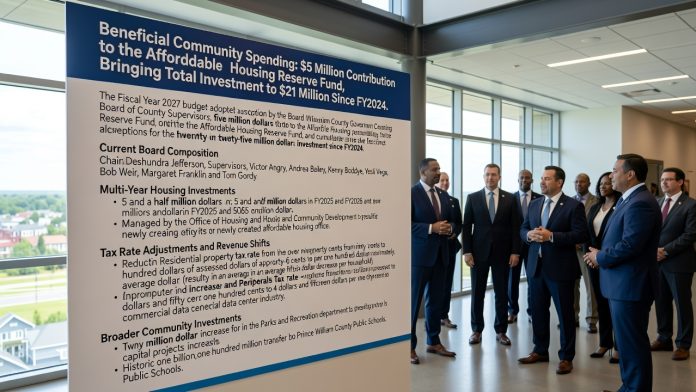
The Prince William County Board of County Supervisors recently adopted the Fiscal Year 2027 budget, which includes a significant financial commitment to local housing initiatives. A key component of this newly approved spending plan is a five million dollar contribution directed specifically toward the Affordable Housing Reserve Fund. This latest allocation brings the countywide investment in affordable housing to a cumulative total of twenty-one million dollars since Fiscal Year 2024. Local leaders have emphasized that this sustained funding is necessary to combat the rising costs of living in the Northern Virginia region.
The current board consists of Chair Deshundra Jefferson, Victor Angry, Andrea Bailey, Kenny Boddye, Yesli Vega, Bob Weir, Margaret Franklin, and Tom Gordy. These elected local leaders worked through various public engagement sessions and extensive staff presentations to finalize a spending plan that balances residential relief with essential community investments. According to official statements from the board, this specific housing funding is dedicated to supporting the development of affordable housing across the community. The supervisors aimed to ensure that long-time residents and vital workforce members are not priced out of the county.
Multi-Year Housing Investments
The five million dollar contribution in the Fiscal Year 2027 budget continues a multi-year financial commitment established by local officials to address regional housing shortages. Previous budget cycles saw dedicated allocations of five and a half million dollars in both Fiscal Year 2025 and Fiscal Year 2026. These combined funds are managed under the broader umbrella of the Office of Housing and Community Development. Within this department, the county has also established a newly created affordable housing office to streamline these growing financial resources and accelerate project delivery.
The path to finalizing these financial commitments involved extensive negotiations among county supervisors during the late stages of the budget approval process. According to the formal budget message from the Occoquan District Supervisor, the final agreement required significant compromise before earning majority approval. The supervisor noted that while it was uncertain if the budget would earn a favorable vote initially, days of deliberation and public engagement helped craft a budget that delivers more for the people. The supervisor ultimately concluded that while the fiscal plan is not perfect, it represents meaningful progress for the community.
Tax Rate Adjustments and Revenue Shifts
While increasing investments in affordable housing, the Fiscal Year 2027 budget simultaneously implements a targeted reduction in the primary residential property tax burden. The real estate tax rate was officially reduced from slightly over ninety cents to approximately eighty-six cents per one hundred dollars of assessed property value. Consequently, this rate adjustment translates to an average residential tax bill decrease of fifty-six dollars for local homeowners compared to the previous fiscal year. This reduction was heavily debated but ultimately approved to provide tangible relief amid ongoing national economic pressures.
To balance the revenue lost from the residential tax relief, the county shifted a larger portion of the overall tax burden onto the expanding commercial data center industry. Officials approved a notable increase in the computer and peripherals tax rate, raising it from four dollars and fifteen cents to four dollars and fifty cents per one hundred dollars of valuation. This strategic revenue shift allows Prince William County to maintain aggressive funding for community programs without severely impacting individual household finances. Data centers represent a massive commercial footprint in the county, making this tax adjustment a highly lucrative mechanism for funding local government operations.
Broader Community Investments
Beyond the specialized focus on affordable housing, the newly adopted budget directs substantial capital toward other public amenities designed to improve local quality of life. The Parks and Recreation department received a twenty million dollar increase specifically earmarked for upcoming capital investments and infrastructure improvements. This influx of funding will support the maintenance, modernization, and expansion of recreational facilities that serve families across all districts within Prince William County. Investing in public spaces remains a core priority for the board as the local population continues to expand rapidly.
Public education also remains a primary beneficiary of the countywide revenue collection and distribution strategy for the upcoming fiscal year. The finalized budget mandates a massive one billion, one hundred million dollar transfer directly to Prince William County Public Schools. This historic educational funding works in tandem with the housing and recreation investments to create a comprehensive approach to local governance and community welfare. Ultimately, the fiscal plan attempts to address the diverse needs of a rapidly growing suburban population through targeted, multi-million dollar community investments.