The adoption of a $5.9 billion budget in Fairfax County has introduced significant shifts in local government spending and revenue generation. Local officials faced a complex financial landscape, navigating a $131.5 million initial funding gap caused by rapidly declining commercial office property values. To balance the massive budget, the county implemented new consumer taxes while simultaneously increasing compensation for public employees. The resulting fiscal plan attempts to reconcile escalating departmental costs with the preservation of essential community programs.
The Fairfax County Board of Supervisors oversaw the lengthy drafting and approval process for this comprehensive financial document. The current board consists of Jeff McKay, Walter Alcorn, Jimmy Bierman, Pat Herrity, Andres Jimenez, Rodney Lusk, Dalia Palchik, Kathy Smith, Dan Storck, and James Walkinshaw. During the budget presentations, County Executive Bryan Hill described the municipality as stable, competitive, and distinctly positioned for future growth. Hill further assured residents that the local government is actively stabilizing its financial reserves while simultaneously advancing its strategic priorities.
Shifting Revenue Streams and Tax Impacts
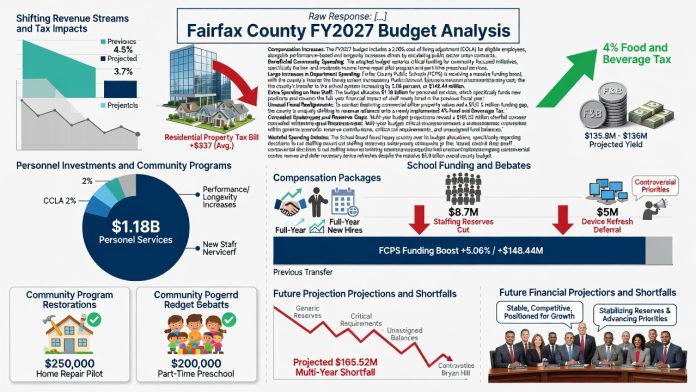
To combat the sharp decline in commercial office real estate values, the county uniquely shifted its revenue reliance toward a newly implemented four percent food and beverage tax. Board Chairman Jeff McKay stated that this alternative revenue stream directly enabled the board to cut the overall property tax rate for residents. Despite this favorable rate reduction, the average residential property tax bill will still increase by approximately $337 this year. This net increase is entirely driven by a steady rise in residential property assessments, which grew between 3.77 percent and 3.99 percent across the region.
Overall revenue growth for the county is currently projected at 3.7 percent for the upcoming fiscal cycle. This figure represents a noticeable drop from the 4.5 percent growth rate observed during the previous year. Financial analysts attribute this revenue deceleration to moderating real estate appreciation and a broader economic normalization following recent volatile market trends. Fortunately, the newly established meals tax is expected to generate approximately $135.8 million to $136 million in its first full fiscal year, effectively neutralizing the initial commercial real estate deficit.
Personnel Investments and Community Programs
A substantial portion of the new budget focuses heavily on retaining and attracting local government employees through enhanced compensation packages. The fiscal plan allocates a staggering $1.18 billion specifically for personnel services across various municipal departments. This specific funding covers a two percent cost of living adjustment for eligible employees, alongside performance-based and longevity increases. These massive compensation adjustments are largely driven by escalating public sector union contracts and the full-year financial impact of staff newly hired in the previous fiscal cycle.
In addition to broad employee compensation increases, the adopted budget restores critical funding for specific community-focused initiatives that were previously slated for elimination. Officials deliberately allocated $250,000 to save the low- and moderate-income home repair pilot program. Another $200,000 was successfully restored to maintain essential part-time preschool services for local families in need. These targeted financial restorations demonstrate a concerted effort by the board to balance large-scale fiscal realignments with direct, localized community assistance.
School Funding and Budget Debates
Fairfax County Public Schools will receive a massive funding boost under the newly adopted countywide fiscal framework. The municipal transfer to the school system is slated to increase by 5.06 percent, which translates to a historic addition of $148.44 million. Superintendent Michelle Reid publicly defended the resulting school budget, describing it as a calculated plan that focuses strictly on the essentials. Reid further emphasized that the approved funding allocation is exactly what the educational system needs to function effectively and support student achievement.
Despite receiving a massive overall funding increase, the School Board faced heavy public scrutiny regarding several controversial internal budget allocations. To close an internal $28.9 million school budget gap, educational administrators implemented an $8.7 million reduction in vital staffing reserves. Furthermore, the district chose to delay necessary technology device refreshes, saving an estimated $5 million in the short term. Critics actively argued that these specific deferrals represent wasteful spending priorities, especially given the massive scale of the $5.9 billion overall county budget.
Future Financial Projections and Shortfalls
Multi-year budget projections reveal underlying fiscal challenges that extend well beyond the current funding cycle. Early financial models indicate a looming $165.52 million overall shortfall for the county in the upcoming fiscal years. This projected multi-year deficit remains largely concealed within generic reserve contributions, critical requirements, and unassigned fund balances. Financial planners warn that addressing this future gap will require continued scrutiny of both departmental spending habits and alternative revenue generation strategies.
The implementation of the FY2027 budget framework sets a complex precedent for how the county will handle ongoing economic pressures. By leveraging consumer taxes to offset commercial real estate losses, local leaders have fundamentally altered the regional revenue model. The ongoing success of this strategy will depend heavily on the actual yields of the food and beverage tax over the next twelve months. Ultimately, officials must carefully monitor these new revenue streams to prevent the projected long-term shortfalls from impacting essential municipal services.
Email At:
Jeff McKay → chairman@fairfaxcounty.gov,
Kathy Smith (Sully District) sully@fairfaxcounty.gov,
Rachna Heizer (Braddock District) braddock@fairfaxcounty.gov,
James Bierman (Dranesville District) dranesville@fairfaxcounty.gov,
Rodney Lusk (Franconia District) franconia@fairfaxcounty.gov,
Walter Alcorn (Hunter Mill District) huntermill@fairfaxcounty.gov,
Andres Jimenez (Mason District) mason@fairfaxcounty.gov,
Daniel Storck (Mount Vernon District) mtvernon@fairfaxcounty.gov,
Dalia Palchik (Providence District) providence@fairfaxcounty.gov,
Pat Herrity (Springfield District) springfield@fairfaxcounty.gov,