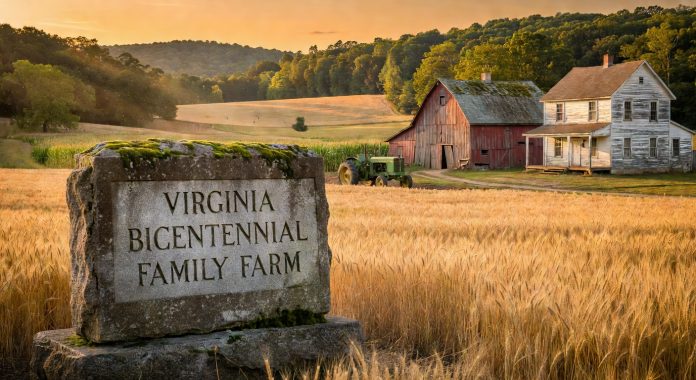
In the 2026 Virginia House of Delegates regular session, Delegate Jason Ballard introduced House Bill 104 to amend state law regarding the Virginia Historic Landmarks Register. The legislation specifically directs the Department of Historic Resources to include bicentennial farms among the types of properties that can be nominated for listing on the register. This step would provide a formal avenue for recognizing farm families in the commonwealth that have maintained ownership of their land for two hundred years or longer.
The bill outlines clear eligibility standards for bicentennial farms. First, the property must have been owned by the same family for at least two hundred consecutive years. Second, the farm must be either lived on or actively farmed by a descendant of the original owners. Third, the property must satisfy any additional requirements that the Department of Historic Resources determines are necessary for nomination. These provisions ensure that only farms with verifiable long-term family ties and ongoing involvement qualify for consideration.
The Virginia Historic Landmarks Register operates under the administration of the Department of Historic Resources as an official catalog of sites important to the historical, architectural, archaeological, and cultural fabric of Virginia. Nominated properties undergo review to confirm their significance before being added to the list. Once listed, properties may benefit from heightened awareness and support for preservation activities, though the core nomination and listing procedures remain unchanged by this bill.
By creating this dedicated category, the measure sought to pay tribute to the farm families whose properties have endured through two centuries of family stewardship. These bicentennial farms represent a tangible connection to Virginia’s agricultural past, where land has been passed from one generation to the next without interruption. The emphasis on continuous ownership and active use by descendants underscores the living nature of this heritage, distinguishing it from purely historical sites no longer in family hands.
Virginia’s farming community provides ample illustration of why such recognition holds value. The state currently has approximately 39,000 farms spread across 7.3 million acres. The typical farm size is 187 acres. Family ownership characterizes 95 percent of these operations, indicating a widespread tradition of keeping agricultural land within family lines. With the average farmer age at 59.2 years, many of these farms are managed by individuals deeply rooted in their family’s history on the land.
The proposal emerged early in the 2026 legislative session, with introduction occurring in January. It received referral to the appropriate committee for consideration. The Department of Planning and Budget evaluated the bill and issued a fiscal impact statement concluding that no budget amendment would be needed. Any administrative costs tied to processing additional nominations for bicentennial farms would be absorbed within the Department of Historic Resources’ current operational budget. The analysis confirmed that the bill would expand eligibility without disrupting existing program management.
On February 18, 2026, the bill was left in the House Committee on Agriculture, Chesapeake and Natural Resources. This action concluded its consideration for the session, preventing the provisions from taking effect.
Legislation of this nature often reflects an appreciation for the historical continuity embodied by long-standing family farms. In Virginia, where agriculture has been a cornerstone since colonial times, farms that achieve the two-century mark in family ownership stand as testaments to resilience against challenges including economic shifts, technological changes, and land use pressures. The bill would have allowed these families to receive official acknowledgment through the established historic landmarks system.
The criteria established in House Bill 104 focus on both the duration of ownership and the active participation of family members in the present day. This dual requirement ensures that the honor is reserved for properties where the family legacy remains vibrant through current habitation or farming activities. The Department of Historic Resources would have the latitude to define supplementary standards, potentially encompassing documentation of the property’s history, evaluation of its physical features, or verification of its ongoing agricultural function.
Such a framework aligns with broader efforts to document and safeguard elements of Virginia’s rural heritage. Farms meeting the bicentennial threshold often contain structures or landscapes that have evolved alongside the families who tend them, offering insights into changing agricultural practices over time. Inclusion on the register could facilitate greater public understanding of these stories while supporting the families’ efforts to maintain their properties.
Although the bill did not proceed further in the 2026 session, its introduction highlighted the unique contributions of multi-generational farm families to the commonwealth. With thousands of family-owned operations forming the backbone of Virginia agriculture, measures aimed at their formal recognition serve to affirm the enduring importance of these enterprises. The detailed eligibility rules in the legislation provide a structured approach to celebrating this particular aspect of the state’s history and economy.