
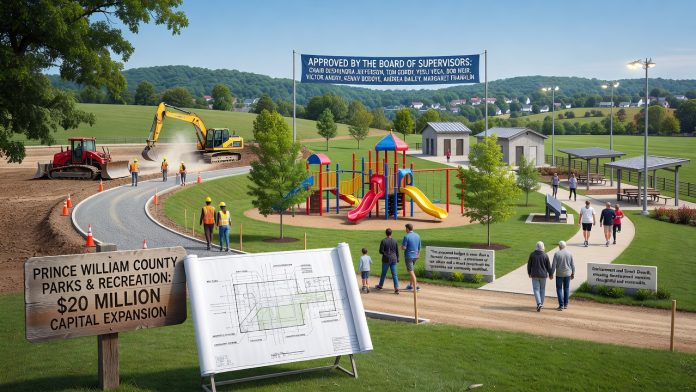
Prince William County is set to implement a sweeping $20 million increase in capital spending for its Parks and Recreation department to significantly upgrade local amenities. This substantial financial commitment aims to enhance existing park infrastructure while actively expanding access to new recreational spaces across the region. Officials have outlined a comprehensive plan that includes the construction of new trails, modern playgrounds, and versatile community spaces designed to serve a growing population. The multimillion-dollar capital infusion represents a major shift in the county’s approach to funding public recreational facilities compared to previous fiscal baselines.
The newly adopted budget was reviewed and advanced by the Prince William County Board of Supervisors, which includes Chair Deshundra Jefferson, Tom Gordy, Yesli Vega, Bob Weir, Victor Angry, Kenny Boddye, Andrea Bailey, and Margaret Franklin. These local leaders navigated a complex financial landscape to balance robust public investments with tangible tax relief for residential property owners. The overarching fiscal plan operates as a blueprint for the coming year, addressing both immediate infrastructure needs and long-term strategic goals. By securing this $20 million allocation, the board has prioritized outdoor community spaces as a core component of the region’s overall development strategy.
Expanding Community Recreational Amenities
A significant portion of the newly approved Parks and Recreation funding will be directed toward specific, highly anticipated infrastructure projects. Key initiatives include the development of the Jefferson Park and Veterans Park Connector Trail, alongside dedicated maintenance resources for the heavily utilized Occoquan Trail. In addition to these pathway expansions, the department will install upgraded field lights, permanent restroom facilities, and modernized picnic and pavilion areas. These targeted improvements are designed to accommodate increased daily usage while providing safer, more accessible environments for residents engaging in outdoor activities.
The official justification for the budget increase emphasizes the necessity of modernizing existing parks while simultaneously expanding public access to diverse recreational amenities. According to the budget message delivered by the County Executive, this financial plan is intended to be much more than a standard ledger of municipal expenses. “This proposed budget is more than a financial document,” the County Executive noted, adding that it serves as “a statement of our values and a direct investment in the priorities our community identified through the Strategic Plan.” This sentiment underscores a deliberate effort to align local government spending with the direct feedback provided by community members.
Balancing Growth and Environmental Sustainability
Beyond the immediate construction of playgrounds and trails, the $20 million capital investment is deeply tied to broader environmental objectives within the county. The strategic allocation of these funds is designed to protect local ecosystems even as the municipality continues to experience rapid residential and commercial expansion. The County Executive explicitly linked these concepts, stating that investments in parks, infrastructure, and planning promote “Environment and Smart Growth, ensuring development remains thoughtful and sustainable.” Consequently, the Parks and Recreation department will be tasked with implementing these upgrades in a manner that preserves the natural landscape for future generations.
The enhancement of local parks is just one facet of a much larger municipal budget that also prioritizes massive investments in the public education system. The financial plan includes a historic transfer to Prince William County Schools, providing an additional $123.5 million over the previous fiscal year’s baseline. This substantial 12.5 percent increase in educational funding operates in tandem with the parks initiative to improve the overall quality of life for families residing in the district. Together, these dual investments in schools and community spaces reflect a comprehensive approach to municipal planning and public welfare.
Taxpayer Impact and Future Outlook
Despite the heavy capital investments in both the Parks and Recreation department and the local school system, county officials managed to secure a reduction in the local property tax burden. The real estate tax rate was successfully reduced from $0.906 to $0.865 per $100 of assessed value for the upcoming fiscal cycle. Because of this strategic rate adjustment, the average residential tax bill is projected to decrease by $56, providing measurable financial relief to local homeowners. This delicate balance of expanding public services while simultaneously lowering the tax rate highlights the county’s focus on efficient fiscal management.
Moving forward, the Parks and Recreation department will begin the complex logistical process of bidding and contracting for these newly funded capital projects. The successful execution of the trail expansions, playground constructions, and facility upgrades will require strict oversight to ensure the $20 million allocation is utilized effectively. Residents can expect to see phased rollouts of these improvements, with projects like the Jefferson Park and Veterans Park Connector Trail serving as early indicators of the program’s progress. Ultimately, this robust financial commitment establishes a strong foundation for the continued growth and sustainability of the county’s public spaces.