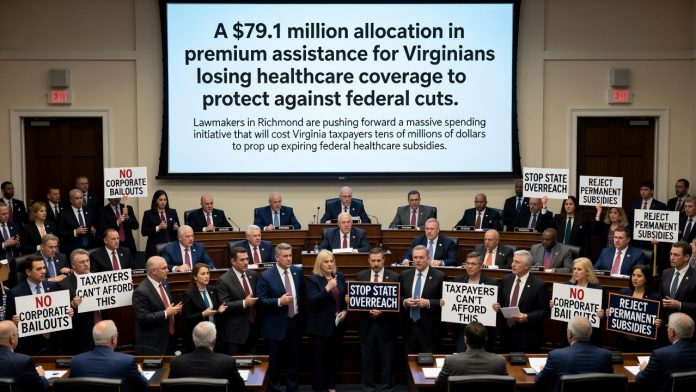
Lawmakers in Richmond are pushing forward a massive spending initiative that will cost Virginia taxpayers tens of millions of dollars to prop up expiring federal healthcare subsidies. Budget Amendment Item 478 heavily impacts the state budget by allocating a staggering $79.1 million from the General Fund for fiscal year 2027 alone. This costly legislative measure acts as a direct, state-funded bailout designed specifically to replace enhanced Affordable Care Act premium tax credits that expired at the end of 2025. Fiscal conservatives across the state are raising severe alarms over this aggressive expansion of state spending to cover predictable federal shortfalls.
Governor Glenn Youngkin initially presented a fiscally responsible budget that rightfully excluded this massive subsidy replacement to protect the state’s bottom line. However, the General Assembly quickly rushed to introduce budget amendments to artificially lower premiums for individuals purchasing coverage through the Virginia state-based marketplace. By overriding the initial executive budget framework, legislators are committing the state to a heavy financial burden that was previously carried by the sprawling federal government. This calculated move effectively forces everyday, hardworking Virginians to permanently subsidize the private healthcare costs of roughly 117,000 specific enrollees through increased state taxation.
Expanding Bureaucracy and State Spending
The creation of new government funds inevitably leads to increased administrative burdens across all involved state agencies. This specific legislative move risks establishing permanent taxpayer funding for what should be temporary federal assistance programs.
The $79.1 million allocation explicitly establishes the Virginia Health Insurance Affordability Fund, which operates as a newly created non-reverting special fund. This unnecessary bureaucratic expansion falls directly under the oversight of the State Corporation Commission and the Virginia Health Benefit Exchange. Creating new non-reverting funds notoriously leads to unchecked government growth, as these financial pools do not return unspent money to the General Fund at the end of the fiscal year. Critics correctly argue that this specific structure lacks proper fiscal restraint and opens the door for continuous taxpayer exploitation in future legislative sessions.
Proponents of the sweeping spending package claim the funds are absolutely necessary to assist individuals earning between 138 percent and 200 percent of the federal poverty income level. The stated goal of the government program is to lower the average monthly net premium for these targeted individuals by as much as 70 percent. While providing assistance might sound appealing to political advocates, it represents a massive wealth transfer funded entirely by taxpayers who are already struggling with record inflation. Funneling general revenue into private Qualified Health Plans ultimately shields massive insurance companies from free market realities while rapidly draining public resources.
Shifting the Federal Burden to Virginia Taxpayers
Lawmakers are effectively transferring the immense cost of federal entitlement programs directly onto local residents. This dangerous financial shift creates an unsustainable economic model that heavily penalizes responsible citizens to prop up a failing system.
The official language of the budget amendment explicitly states that the funding is targeted to individuals who purchase health insurance from Qualified Health Plans sold through the marketplace. Furthermore, the legislation provides highly controversial flexibility for the Health Benefit Exchange to adjust the monthly premium reduction payment up or down as enrollment and fund balances inevitably change. This vague legislative language essentially gives unelected state bureaucrats the unilateral power to manipulate taxpayer funds without direct voter accountability or strict legislative oversight. The amendment even allows the exchange to request additional funding from the Federal Uncertainty Contingency Fund, signaling that the initial $79.1 million may just be the beginning of this spending spree. Taxpayers simply cannot afford to become the permanent safety net for flawed federal mandates.
The Virginia Health Benefit Exchange estimates that roughly 100,000 people in the state might leave the marketplace this year due to losing access to enhanced assistance and being priced out of coverage. This projected mass exodus heavily highlights the fundamental failures and unsustainable nature of the Affordable Care Act without constant government intervention. Instead of allowing the free market to naturally correct these inflated insurance prices, state lawmakers are actively choosing to artificially suppress premiums using public dollars. Subsidizing a broken healthcare system only delays necessary economic reforms and practically guarantees that healthcare costs will continue to rise across the board.
A Desperate Need for Fiscal Responsibility
Safeguarding the economic future of the Commonwealth demands a renewed commitment to fiscal restraint. Lawmakers must prioritize reducing overall expenditures rather than inventing entirely new avenues for systemic overspending.
The financial threat to Virginia taxpayers could have been significantly worse, as the Senate initially proposed an astonishing $200 million allocation for this exact same subsidy purpose. While the final $79.1 million figure is lower, it still represents a highly dangerous precedent of state government absorbing the exorbitant costs of expired federal entitlement programs. When the federal government correctly decides to pull back on excessive domestic spending, states should never immediately rush to fill the financial void with their own citizens’ money. Fiscal conservatives maintain that the state government must strictly prioritize reducing the overall budget rather than bailing out insurance markets.
Protecting the long-term financial health of Virginia requires strict adherence to conservative budgeting principles and a firm, unwavering rejection of unnecessary corporate bailouts. The $79.1 million allocation for state premium assistance is a crystal-clear example of government overreach that heavily penalizes responsible, taxpaying citizens. Lawmakers must focus their efforts on eliminating rampant waste and fraud within existing programs rather than inventing new special funds to mask the failures of federal healthcare mandates. Ultimately, preserving taxpayer money and reducing the size of government should remain the absolute highest priority for the General Assembly as they navigate future fiscal years.