
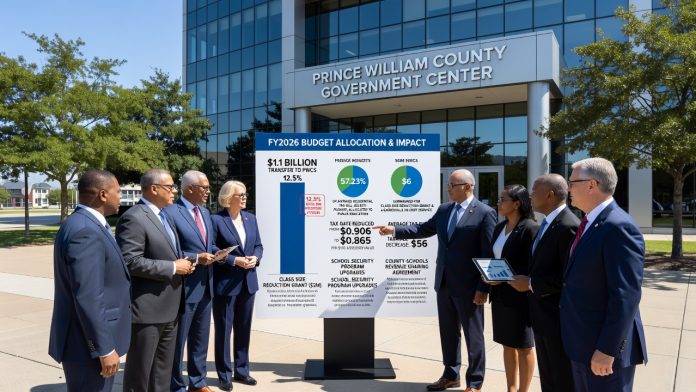
The Prince William County Board of Supervisors has officially approved a substantial financial package that includes a massive $1.1 billion transfer to Prince William County Public Schools. This historic funding allocation represents a 12.5 percent increase in department spending over the previous fiscal cycle, injecting an additional $123.5 million into the local education system. Local officials have structured this budget to specifically target class size reductions and comprehensive school security enhancements across the rapidly growing district. Furthermore, the financial framework seeks to balance these massive educational investments with tangible tax relief for local property owners.
The current Prince William County Board of Supervisors, which includes Deshundra Jefferson, Victor Angry, Andrea Bailey, Margaret Franklin, Kenny Boddye, Yesli Vega, Bob Weir, and Tom Gordy, authorized this comprehensive budget framework after extensive public deliberations. Their collective decision strictly aligns with the established County-Schools Revenue Sharing Agreement, a foundational policy that dictates how local tax revenues are divided between municipal operations and educational needs. Through this collaborative financial arrangement, the total all-funds budget for the school system will experience a significant 20.27 percent growth trajectory compared to the previous fiscal year. This revenue sharing model ensures that as the county’s economic base expands, the public school system automatically receives a proportional share of the financial benefits.
Despite the massive influx of educational funding, property owners will actually see a reduction in their local real estate tax rate under the newly adopted fiscal plan. The approved budget officially lowers the countywide real estate tax rate from $0.906 to $0.865 per $100 of assessed property value. Because of this downward adjustment, the average residential tax bill is projected to decrease by approximately $56, balancing the need for public investment with immediate taxpayer relief. County leaders emphasized that guided by the strategic plan, the adopted budget successfully reduces the tax rate while still prioritizing core community services like education and public safety.
Prioritizing Classroom Environments and Security
A primary focus of the newly approved $1.1 billion transfer is a dedicated effort to improve the daily learning environment for students through a specialized Class Size Reduction Grant. This specific grant provides up to $2 million to help school administrators hire additional instructional staff and effectively lower the student-to-teacher ratio in historically crowded classrooms. Furthermore, the massive funding package heavily subsidizes the School Security Program to upgrade physical infrastructure and safety protocols across various educational campuses. These specific financial allocations reinforce the local government’s frequently stated position that safety and security remains an absolute cornerstone of the Prince William County community.
To provide total transparency regarding how individual tax dollars are spent, county financial documents break down the exact allocation of the average residential property tax bill. Public education accounts for the vast majority of this civic contribution, with $2,927, or roughly 57.23 percent, of the average bill going directly to Prince William County Public Schools. An additional $6 from each average tax bill is specifically earmarked to fund the Class Size Reduction Grant and cover the ongoing debt service for the recently constructed Gainesville High School. By publishing these exact figures, municipal leaders hope to demonstrate exactly how the $123.5 million funding increase translates to the individual household level.
Strategic Growth and Fiscal Stability
The massive educational investment is fundamentally guided by the broader strategic plan established by Prince William County leadership to manage unprecedented regional growth. According to official budget documents, the primary objective of the financial plan is to ensure continued investment in the county’s strategic priorities while maintaining strict long-term fiscal stability. This careful balancing act requires the local government to adequately fund mobility, infrastructure, environmental sustainability, and overall quality of life alongside its massive educational commitments. The historic $1.1 billion transfer proves that public schooling remains at the very top of that strategic priority list for local policymakers.
The $123.5 million increase for the school system is part of a much larger upward trend in overall county expenditures for the upcoming fiscal cycle. While the school system’s all-funds budget is jumping by more than twenty percent, the municipal county government budget is also increasing by 10.48 percent to maintain essential public services. Combined, the total all-funds budget for Prince William County will increase by a total of 15.15 percent from the previous fiscal year. This overall budget expansion reflects the escalating operational costs associated with managing one of the most rapidly developing economic regions in the Commonwealth of Virginia.
As the new fiscal year rapidly approaches, school district administrators will begin the complex logistical process of deploying the $1.1 billion transfer to address their most pressing operational needs. The successful implementation of the Class Size Reduction Grant and the expanded School Security Program will be closely monitored by both elected officials and local taxpayers throughout the year. Ultimately, this comprehensive budget represents a defining commitment by Prince William County to heavily prioritize public education funding for future generations. At the same time, the approved fiscal plan demonstrates an active attempt by the local government to ease the annual tax burden on its residential property owners through targeted rate reductions.
Email the Board of Supervisors At:
Chair At-Large (Deshundra Jefferson) – djefferson@pwcgov.org,
Brentsville (Tom Gordy): tgordy@pwcgov.org,
Coles (Yesli Vega): yvega@pwcgov.org,
Occoquan (Kenny Boddye): kboddye@pwcgov.org,
Potomac (Andrea Bailey): abailey@pwcgov.org,
Woodbridge (Jeannie LaCroix): jlacroix@pwcgov.org,
General Board: bocs@pwcgov.org,