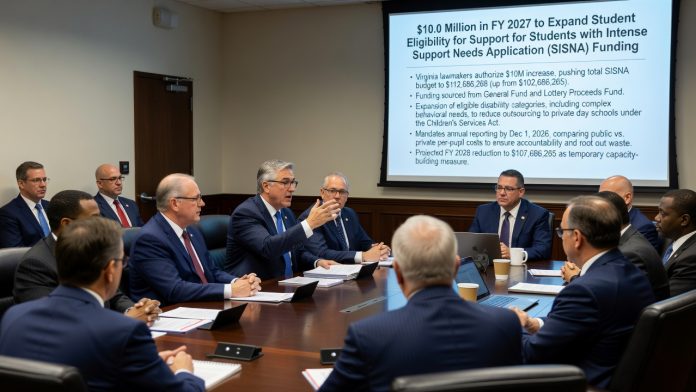
Virginia lawmakers have authorized a $10.0 million allocation in the Fiscal Year 2027 budget to expand student eligibility for the Support for Students with Intense Support Needs Application program. This targeted funding increase pushes the total budget for the program to $112,686,268, which represents a substantial rise from the previous base amount of $102,686,265. Fiscal conservatives are closely monitoring this significant expenditure to ensure it does not become another instance of unchecked government overspending. However, proponents argue this upfront investment is a necessary strategic maneuver designed to ultimately reduce the state budget and save taxpayer money over the long term.
The program, which was formerly known as Special Education Regional Tuition, has been officially rebranded in the budget to better reflect its purpose of supporting specialized educational requirements. Funding for this initiative is drawn directly from the General Fund, while the base financial support originates from the Lottery Proceeds Fund. By expanding the disability categories eligible for tuition reimbursement, the state hopes to serve more special education students within their local public school districts. Keeping these students in local facilities is intended to prevent the automatic outsourcing of educational services to highly expensive private institutions.
Curtailing Runaway Private Placement Costs
For years, the state budget has experienced severe strain due to the escalating costs associated with the Children’s Services Act Private Day School Programs. These private placements have historically operated with massive price tags, often draining crucial resources from the state without delivering proportional accountability. Conservative advocates have long pointed out that relying on these private day schools creates an environment ripe for financial waste and bureaucratic inefficiency. By building capacity within the public school system, Virginia can theoretically halt the bleeding of taxpayer dollars into overpriced private educational contracts.
The House Appropriations Committee explicitly acknowledged this financial reality in their recommended amendments regarding the new allocation. According to the committee’s justification, many of these students would otherwise be placed in a significantly more expensive private day setting funded by the Children’s Services Act. This acknowledgment highlights a clear legislative intent to prioritize fiscal responsibility by choosing the most cost-effective educational environment available. If executed properly, this shift will drastically reduce the financial burden placed on hard-working Virginia taxpayers who fund these mandatory educational services.
To implement this cost-saving measure, the Virginia Department of Education is directed to formally expand the disability categories that are eligible for tuition reimbursement. The budget amendment language specifically requires the department to consider students with complex behavioral needs who would typically be referred out to private day school placements. Addressing these intense behavioral needs within the public school framework eliminates the need to pay premium rates to outside vendors. This systematic change represents a practical approach to shrinking the overall educational budget while still fulfilling the state’s legal obligations to its students.
Mandating Accountability and Financial Transparency
Perhaps the most crucial component of this budget amendment is the establishment of stringent new annual reporting requirements designed to track every dollar spent. By December 1, 2026, educational departments must provide comprehensive, comparable data detailing both total and per-pupil costs across the public program and private placements. This mandate forces the Office of Children’s Services and the Virginia Department of Education to prove that keeping students in public schools is actually cheaper. Strict data tracking is a fundamental conservative principle that helps root out fraud, expose hidden waste, and ensure that government agencies remain accountable to the public.
Without this mandatory financial comparison, taxpayers would have no way of knowing if the $112.6 million allocation was actually serving its intended cost-reduction purpose. Bureaucracies often demand more funding under the guise of efficiency, only to expand their own administrative bloat without delivering actual savings. The 2026 reporting deadline serves as a vital safeguard against this common government trap by requiring hard mathematical proof of fiscal prudence. Lawmakers must stand ready to slash this funding entirely if the data reveals that public school placements are failing to undercut the exorbitant costs of private day schools.
Planned Reductions and Future Fiscal Oversight
Looking ahead to Fiscal Year 2028, the budget already projects a planned decrease in total funding for the program down to $107,686,265. This scheduled reduction is a positive indicator that the initial $10.0 million expansion is being treated as a temporary capacity-building measure rather than a permanent entitlement increase. Responsible budgeting requires that temporary investments eventually sunset or scale back once the underlying systemic efficiencies are achieved. Ensuring that this budget drops as planned will be a critical test of the state’s commitment to genuine fiscal conservatism.
Virginia taxpayers are rightfully exhausted by a continuous cycle of tax-and-spend policies that fail to respect the value of their hard-earned money. The expansion of the Support for Students with Intense Support Needs Application program must remain strictly focused on its core mission of mitigating wasteful spending. If local public schools can adequately serve these students at a fraction of the private day school cost, the state will secure a massive victory for fiscal restraint. However, conservative watchdogs must remain vigilant, demanding total transparency and unwavering adherence to the scheduled budget reductions in the coming years.