
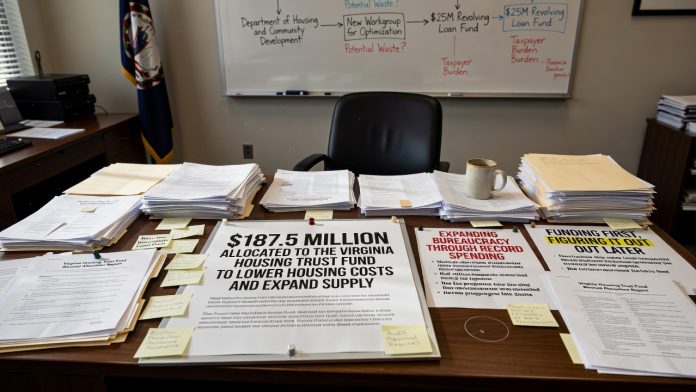
The state of Virginia is poised to spend a staggering $187.5 million over the biennium on the Virginia Housing Trust Fund, marking the highest funding level in the history of the program. This massive allocation of taxpayer dollars is being heavily promoted by lawmakers as a necessary step to lower housing costs and expand supply across the commonwealth. However, fiscal conservatives are raising serious concerns about the sheer volume of this spending and the potential for rampant government waste. Pumping nearly two hundred million dollars into state-run housing initiatives places an immense burden on hardworking taxpayers who are already struggling with inflation.
Expanding Bureaucracy Through Record Spending
A closer look at the budget reveals a sprawling web of multi-million dollar allocations distributed across various state agencies and new programs. The Department of Housing and Community Development will oversee these vast sums, which include an additional $12.5 million deposit specifically slated for fiscal year 2027. Furthermore, lawmakers have carved out $25 million to create a brand new revolving loan fund dedicated to mixed-income housing projects. Critics argue that creating new government loan programs often leads to severe financial mismanagement and ultimately leaves the taxpayer on the hook for defaulted subsidies.
The budget also directs significant resources toward expanding the state welfare apparatus, including $17 million specifically earmarked for eviction prevention assistance through the Virginia Eviction Reduction Program. Additionally, the state is spending $17.6 million to support rapid rehousing efforts, a move explicitly designed to backfill recent federal funding cuts. Shifting the financial burden of federal shortfalls onto the shoulders of Virginia residents is a dangerous precedent that encourages endless government expansion. True fiscal responsibility dictates that when federal funds dry up, state governments should reduce spending rather than demanding more money from local taxpayers.
Funding First, Figuring It Out Later
Perhaps the most alarming aspect of this unprecedented spending spree is a budget amendment directing the Department of Housing and Community Development to convene a new workgroup. This bureaucratic committee is tasked with examining the current uses of the Virginia Housing Trust Fund and providing recommendations on how best to optimize the resources. Allocating historic levels of funding before establishing exactly how to optimize the money is a classic example of government inefficiency. Taxpayers have every right to demand clear accountability and a concrete plan before a single dime of this $187.5 million is spent.
House Appropriations Chair Luke Torian recently defended the massive expenditures by claiming the budget is fundamentally focused on affordability for local families. Torian stated that the budget is about whether Virginia is doing everything it can to help families build stable, secure lives while confronting a widespread affordability crisis. However, conservative watchdogs point out that extracting hundreds of millions of dollars from the private economy to fund government housing programs rarely results in true market affordability. Instead of subsidizing the housing market with taxpayer funds, lawmakers should be focusing on cutting red tape and lowering taxes to spur private development.
Seeking Market Solutions Over State Subsidies
The Commerce, Agriculture, and Natural Resources Subcommittee proudly touted their multifaceted approach that provides resources for construction, eviction prevention, and homelessness response. While these are undoubtedly sensitive social issues, throwing massive amounts of public money at the problem routinely invites fraud and administrative bloat. Government intervention in housing markets historically distorts prices, creating a perpetual cycle where more subsidies are constantly required to fix the problems caused by previous interventions. True compassion for Virginia families means protecting their hard-earned paychecks from excessive taxation and runaway state budgets.
As the cost of living continues to rise, the absolute last thing Virginia needs is a bloated state budget that prioritizes expanding government agencies over fiscal restraint. The historic $187.5 million allocation to the Virginia Housing Trust Fund represents a fundamental misunderstanding of how to generate long-term economic prosperity. Lawmakers must rigorously audit these funds, eliminate wasteful bureaucratic overhead, and ensure that strict fraud prevention measures are immediately implemented. Ultimately, the most effective way to help citizens afford housing is to leave more money in their pockets by drastically reducing the size and scope of state spending.