
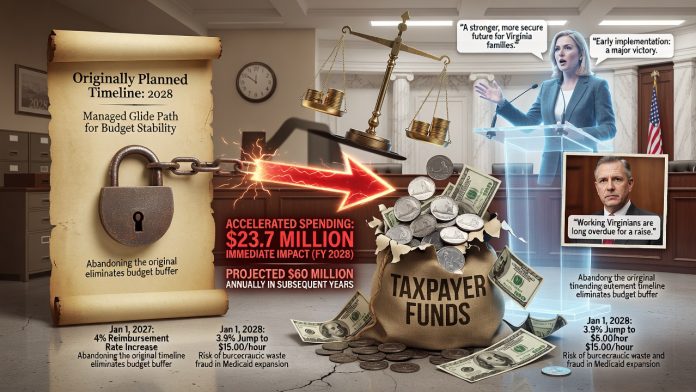
Virginia taxpayers are bracing for a significant financial impact following the latest adjustments to the state budget regarding home care worker salaries. Lawmakers have decided to accelerate previously planned wage increases, moving the timeline up from the originally scheduled date in 2028. This rapid escalation in state-mandated spending raises serious concerns about fiscal responsibility and the growing burden on hardworking citizens. While supporting healthcare workers is a noble goal, rushing these unfunded mandates threatens to inflate the budget unnecessarily.
The Financial Burden of Rushed Timelines
The Department of Medical Assistance Services estimates that accelerating these personal care attendant costs will siphon a staggering amount of money from state coffers. Projections show the immediate impact will reach $23.7 million statewide in fiscal year 2028 alone. Furthermore, the long-term financial forecast is even more troubling, with costs expected to approach $60 million annually in subsequent years. Such dramatic increases in recurring expenses represent a textbook example of unchecked government spending that leaves taxpayers footing the bill.
Under the revised schedule, the state will enforce a four percent reimbursement rate increase on January 1, 2027, followed by another 3.9 percent increase on January 1, 2028. These adjustments directly impact Medicaid programs, specifically targeting personal care, respite, and companion services within both consumer-directed and agency-directed frameworks. By abandoning the original, more measured 2028 timeline, officials are stripping away the essential buffer needed to ensure the overall budget remains balanced. This hasty approach eliminates any opportunity to evaluate the true economic impact of these massive raises before committing millions in taxpayer funds.
Political Promises Versus Fiscal Reality
Governor Abigail Spanberger recently championed this accelerated spending, claiming the finalized budget charts a path toward a stronger and more secure future for Virginia families. She specifically highlighted the early implementation of home care worker salary increases as a major victory for her administration. Similarly, Speaker of the House Don Scott justified the massive expenditure by stating that working Virginians are long overdue for a raise. However, these political talking points conveniently ignore the harsh reality that every dollar spent on accelerated mandates must be extracted directly from the pockets of Virginia taxpayers.
Previously, most consumer-directed home care workers outside of Northern Virginia earned $13.88 an hour, which sat above the prior minimum wage of $12.77. The newly accelerated budget now aggressively forces the minimum wage for these specific workers to $13.75 per hour in 2027, before jumping to $15.00 per hour in 2028. Artificially inflating wages through government intervention often leads to severe market distortions and increased costs for essential state services. Conservative fiscal policy dictates that the free market, rather than heavy-handed government mandates, should determine compensation to prevent runaway inflation and bureaucratic waste.
Straining Medicaid and Inviting Waste
Expanding the budget for the Department of Medical Assistance Services at such an aggressive pace opens the door for significant administrative waste and potential fraud. Medicaid is already one of the largest and most complex expenditures in the state budget, requiring strict oversight to protect taxpayer investments. Pumping an additional $60 million annually into this system without allowing the originally planned timeline to unfold reduces the state’s ability to implement proper cost-control measures. Rushing these funds through the system practically guarantees that a portion of taxpayer money will be lost to bureaucratic inefficiency and poor oversight.
Fiscal conservatives have long argued that adhering to carefully planned legislative timelines is crucial for maintaining a healthy and sustainable state economy. The original 2028 target date for these salary increases was established to provide a manageable glide path for the state budget. Tearing up that timeline to score immediate political points demonstrates a reckless disregard for long-term fiscal stability and economic prudence. Lawmakers must prioritize reducing the budget and eliminating unnecessary spending rather than continuously expanding the size and scope of state-funded entitlement programs.
Protecting the Virginia Taxpayer
Ultimately, the decision to accelerate home care worker salaries serves as a stark reminder of the fundamental differences in governing philosophies in Richmond. While some politicians view the state budget as an endless pool of resources to fund their policy priorities, conservatives recognize that true affordability comes from lower taxes and reduced government spending. Saving taxpayer money should always remain the primary objective of any responsible legislative body entrusted with the management of public funds. Reversing this trend of overspending is absolutely essential to ensure that Virginia remains a prosperous and economically competitive state for generations to come.