
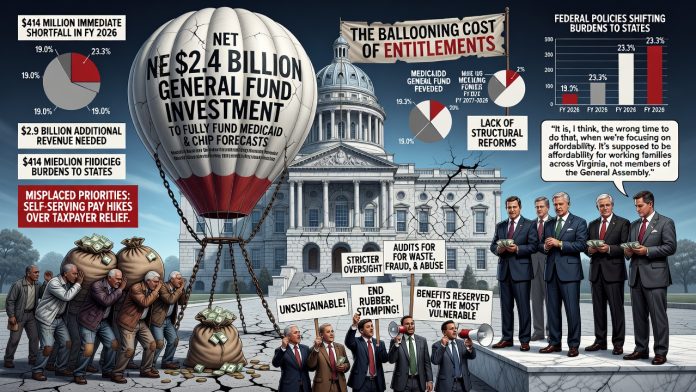
Virginia taxpayers are bracing for a massive financial hit as the upcoming fiscal year 2026 through 2028 biennium budget includes a staggering net $2.4 billion General Fund investment to fully fund Medicaid and CHIP forecasts. This massive spending increase highlights a rapidly expanding welfare state that continues to consume an ever-growing portion of the state’s financial resources. Driven by shifting federal policies and expanding entitlement programs, this budgetary explosion places a severe burden on hardworking families who are ultimately footing the bill. Conservative leaders are raising alarms over this unchecked government spending, warning that such astronomical budget allocations are entirely unsustainable for the Commonwealth.
The Ballooning Cost of Entitlements
The financial figures surrounding the Department of Medical Assistance Services paint a troubling picture of fiscal mismanagement and runaway entitlement growth. According to recent forecasts, an estimated $2.9 billion in additional General Fund revenue was needed for health care in the upcoming biennium just to maintain current service levels. Before even factoring in these future increases, the state already faced an immediate $414 million shortfall in fiscal year 2026 simply to meet its existing obligations. Appropriating a net $2.4 billion to cover these massive shortfalls diverts vital taxpayer dollars away from infrastructure, public safety, and potential tax relief initiatives.
A historical look at Medicaid’s share of the state budget reveals a deeply concerning upward trajectory that demands immediate legislative intervention. During the height of the recent pandemic, enhanced federal funding temporarily masked the problem by reducing Medicaid’s share of the General Fund to roughly 19.0 percent. However, as those federal subsidies expired, the program’s share rapidly rebounded to consume 23.3 percent of the General Fund in fiscal year 2026. With this new multi-billion dollar investment, Medicaid is projected to devour an even larger percentage of the state budget in fiscal years 2027 and 2028.
Federal Policies and Local Burdens
This massive spending hike was justified by updated agency forecasts showing that the anticipated costs for Medicaid, the Children’s Health Insurance Program, and the Family Access to Medical Insurance Security program came back much higher than originally budgeted. A significant portion of this budget crisis is exacerbated by federal policies that intentionally shift additional cost burdens directly onto state governments. Instead of pushing back against these federal mandates, state officials have largely accepted the financial strain, leaving local taxpayers to cover the widening deficits. Fiscal conservatives argue that continually absorbing these shifted costs without demanding structural reforms is a guaranteed recipe for long-term economic instability in Virginia.
Rather than aggressively auditing these sprawling entitlement programs for waste, fraud, and abuse, the Virginia House of Delegates simply included a provision to fully fund the inflated forecasts. Writing a blank check to cover ballooning agency estimates does absolutely nothing to protect the hard-earned money of Virginia citizens. A thorough review of eligibility requirements and operational efficiencies within the Department of Medical Assistance Services could potentially save the state hundreds of millions of dollars annually. Lawmakers have a moral obligation to ensure that taxpayer funds are spent efficiently, rather than blindly expanding budgets to accommodate unchecked agency demands.
Misplaced Priorities in Richmond
Compounding the frustration over this massive entitlement expansion is the broader context of the state budget package, which has drawn sharp criticism for entirely misplaced priorities. Alongside the billions directed toward expanding Medicaid, the budget package shockingly included a 278 percent pay raise for lawmakers in Richmond. This self-serving legislative pay hike has outraged taxpayers who are currently struggling with historic inflation and rising living costs. Fiscal watchdogs point out the stark disconnect between out-of-touch politicians and the everyday citizens they are elected to serve.
State Senator Mark Obenshain strongly criticized the broader budget package, stating, “It is, I think, the wrong time to do that, when we’re focusing on affordability.” He emphasized the legislative duty to taxpayers by adding, “It’s supposed to be affordability for working families across Virginia, not members of the General Assembly.” This powerful sentiment resonates deeply with conservative taxpayers who expect their elected officials to cut wasteful spending rather than expanding welfare programs. True public service requires making difficult financial decisions to protect the state’s economic future, rather than rewarding politicians while the state budget balloons out of control.
The Path to Fiscal Responsibility
Moving forward, Virginia lawmakers must prioritize comprehensive structural reforms to Medicaid and CHIP to curb this unsustainable trajectory of government growth. Implementing stricter oversight, aggressively rooting out fraudulent claims, and ensuring that benefits are reserved strictly for the most vulnerable populations are essential steps toward balancing the budget. Furthermore, the state must challenge federal policies that unfairly burden local taxpayers with the costs of national entitlement expansions. Without these crucial conservative reforms, the state risks drowning in entitlement debt and will inevitably be forced to impose even higher tax burdens on its citizens.
The upcoming fiscal year 2027 through 2028 biennium budget serves as a critical crossroads for the financial future of the Commonwealth. Taxpayers are rightfully demanding transparency, strict accountability, and a definitive end to the rubber-stamping of massive agency budget requests. By reining in the runaway costs of the Department of Medical Assistance Services, Virginia can protect its long-term economic prosperity. It is time for Richmond to embrace fiscal discipline, reduce wasteful spending, and secure a financially responsible future for the next generation of Virginians.































