
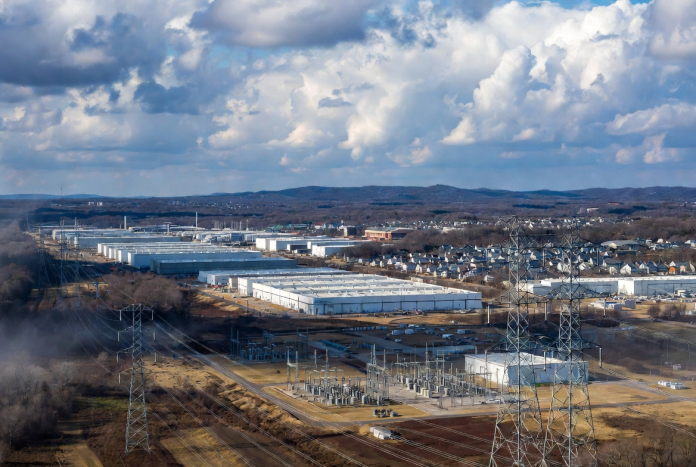
Rapid data center construction across Loudoun and Prince William Counties is forcing a massive expansion of high-voltage transmission lines and substations that scientific research associates with higher rates of childhood leukemia and other serious illnesses. Loudoun County already contains the world’s densest concentration of these facilities, with roughly 250 operational data centers and more than 100 additional projects in the pipeline. Prince William County lists 54 completed buildings, 31 under construction, and dozens more planned or under review, pushing the total of facilities built or advancing toward 150. The resulting surge in electricity demand has prompted utilities to propose and build new 500-kilovolt and 230-kilovolt corridors plus multiple substations near homes and schools.
Surging Power Demand Drives Infrastructure Expansion
Power consumption in Loudoun County alone climbed 233 percent between 2021 and 2025, rising from about 2 gigawatts to 5.33 gigawatts. Projections point to still steeper growth as artificial-intelligence workloads increase. Dominion Energy and the regional grid operator PJM have answered with plans for additional gigawatts delivered through new high-voltage lines, including the Golden-to-Mars reliability loop, Aspen-to-Golden connections, and proposals for underground high-voltage direct-current routes ending at Loudoun substations. Similar upgrades are advancing in Prince William County to serve Innovation Park and eastern data-center zones. Each new line and substation places more residential neighborhoods and schools within continuous magnetic-field exposure ranges linked in studies to elevated disease risk.
Research Links Magnetic Fields to Childhood Leukemia and Adult Cancers
Multiple pooled analyses of residential magnetic-field exposure have documented statistically significant increases in childhood leukemia at field strengths above 0.3 to 0.4 microtesla. One analysis of nine studies covering more than three thousand cases found a twofold elevation at the highest exposure category. Government-funded investigations in several countries have repeatedly confirmed odds ratios of 1.5 or greater, while industry-supported studies have tended to report null results. The International Agency for Research on Cancer classified extremely low-frequency magnetic fields as a Group 2B possible human carcinogen on the strength of this evidence. Adult populations show parallel associations with leukemia, brain cancer, and both male and female breast cancer according to successive meta-analyses.
Outdated Guidelines Leave Families Unprotected
Existing exposure limits issued by the Institute of Electrical and Electronics Engineers and the International Commission on Non-Ionizing Radiation Protection address only short-term nerve stimulation. These guidelines allow magnetic-field levels thousands of times higher than those associated with elevated cancer risk in epidemiological data. Families living near the expanding network of transmission lines and substations therefore receive no meaningful safeguard against the chronic, multi-year exposures that research identifies as problematic. Children attending nearby schools experience daily exposure during critical developmental years. The same body of research notes suggestive links between long-term residential magnetic fields and Alzheimer’s disease, adding further concern for multigenerational households.
Democratic-Led Policies Prioritize Growth Over Family Safety
Local governments in Loudoun and Prince William Counties have begun tightening data-center approvals, shifting away from by-right zoning toward special-exception review. Yet the accompanying high-voltage infrastructure continues to advance under state-level processes that give limited weight to long-term magnetic-field health findings. Democratic-led state policies that emphasize rapid technology-sector expansion have accelerated transmission construction without requiring protective setbacks from homes and schools. The result is a growing inventory of power lines and substations placed closer to residential communities than the scientific record supports.
Practical Protections Exist but Remain Unused
Protective setbacks measured in hundreds of meters, combined with underground placement where feasible and low-emission engineering designs, remain practical steps capable of reducing population exposure. Magnetic fields decline rapidly with distance, falling toward background levels beyond roughly three hundred meters in many configurations. Governments that decline to mandate such safeguards place the health of children and families secondary to commercial expansion. The documented associations with leukemia, brain cancer, breast cancer, and neurodegenerative disease make continued inaction difficult to justify.
Virginia’s data-center boom has generated substantial tax revenue and economic activity. The accompanying power infrastructure, however, carries measurable health costs that fall most heavily on nearby households. Research spanning more than four decades shows consistent patterns once funding bias is taken into account. Families in Loudoun and Prince William Counties deserve infrastructure decisions that place the well-being of children and long-term residents above unconstrained industrial growth. Evidence-based siting standards and engineering controls offer a clear path to balance economic development with the duty to protect the most vulnerable.
Data-Center Expansion in Northern Virginia Accelerates Transmission and Substation Construction Amid Health Research
Northern Virginia’s concentration of data centers continues to expand, generating substantial new demand for high-voltage transmission lines and substations in Loudoun and Prince William Counties. Loudoun County holds the largest cluster of such facilities worldwide, with approximately 250 operational data centers and more than 100 additional projects in various stages of development. Prince William County reports 54 completed data-center buildings, 31 under construction, 51 planned projects, and roughly a dozen applications under review, for a combined total approaching 150 facilities built or advancing. Electricity consumption tied to these operations has risen sharply, prompting utilities to plan and construct extensive new grid infrastructure.
Rapid Load Growth Requires New High-Voltage Corridors
Loudoun County’s power use increased 233 percent from 2021 to 2025, moving from about 2 gigawatts to 5.33 gigawatts. Independent forecasts project still higher loads as artificial-intelligence applications scale. Dominion Energy and the regional grid operator PJM have advanced multiple high-voltage projects to meet the demand, including 500-kilovolt and 230-kilovolt transmission lines that form reliability loops around Ashburn, new substations, and proposals for underground high-voltage direct-current corridors capable of delivering several thousand megawatts into Loudoun. Comparable upgrades are under way or proposed in Prince William County to serve expanding data-center zones near Manassas and eastern portions of the county. Many of these lines and substations are sited in or near residential areas and educational facilities.
Epidemiological Findings on Magnetic Fields and Cancer
Epidemiological research has examined associations between residential exposure to extremely low-frequency magnetic fields from power infrastructure and various health outcomes. Pooled analyses published around 2000 synthesized data from multiple countries and reported elevated childhood-leukemia risk at magnetic-field levels above 0.3 to 0.4 microtesla, with odds ratios ranging from approximately 1.5 to 2.0 in the highest exposure categories. The International Agency for Research on Cancer classified these fields as Group 2B, possibly carcinogenic to humans, on the basis of limited evidence for childhood leukemia. Subsequent government-supported meta-analyses have continued to observe statistically significant associations at similar field strengths.
Adult Cancer Associations and Funding Patterns
Studies of adult populations have identified modest elevations in risk for leukemia, brain cancer, and breast cancer in both men and women. Meta-analyses of occupational and residential data have produced relative risks in the range of 1.14 to 1.18 for brain cancers and pooled odds ratios near 1.07 to 1.32 for breast cancer depending on the specific analysis and subgroup. Evidence for other outcomes, including neurodegenerative disease, remains more limited and is characterized by reviewing agencies as inadequate or uncertain. A consistent pattern appears in the childhood-leukemia literature when studies are stratified by funding source: government or independently funded investigations more frequently report positive associations, while industry-supported studies more often report null findings.
Scientific Reviews and Current Exposure Guidelines
Scientific review bodies including the World Health Organization and European committees have described the childhood-leukemia association as limited or weak and have noted the absence of established biophysical mechanisms or consistent experimental confirmation. Current exposure guidelines issued by the Institute of Electrical and Electronics Engineers and the International Commission on Non-Ionizing Radiation Protection were developed to prevent acute effects such as nerve stimulation and allow magnetic-field levels substantially higher than those associated with the epidemiological findings. Critics of the guidelines observe that they were not designed to evaluate chronic residential exposures lasting many years.
Local Zoning Changes and Ongoing Infrastructure Decisions
Local governments in both Loudoun and Prince William Counties have recently adjusted zoning frameworks, moving data centers from by-right approval toward special-exception or special-use-permit processes. Transmission lines remain subject to state-level review by the State Corporation Commission, while substations generally fall under local zoning. The cumulative effect of the data-center boom is a denser network of high-voltage infrastructure whose magnetic fields will affect a larger number of nearby residences and schools. Magnetic-field strength declines with distance from the source, and engineering options such as underground placement or optimized conductor configurations can reduce exposures.
Public-health discussions continue to weigh the observed statistical associations against the lack of definitive causal proof and the practical challenges of serving rapidly growing electricity demand. Ongoing research aims to clarify remaining uncertainties regarding both childhood and adult outcomes. Policy options under consideration include greater attention to setback distances from sensitive locations and continued monitoring of the scientific literature as new transmission and substation projects move forward in Northern Virginia.
Email the Board of Supervisors at:
Phyllis J. Randall (Chair, At-Large) – Phyllis.Randall@loudoun.gov,
Michael R. Turner (Vice Chair, Ashburn District) – Mike.Turner@loudoun.gov,
Juli E. Briskman (Algonkian District) – Juli.Briskman@loudoun.gov,
Sylvia R. Glass (Broad Run District) – Sylvia.Glass@loudoun.gov,
Caleb Kershner (Catoctin District) – caleb.kershner@loudoun.gov,
Matthew F. Letourneau (Dulles District) – Matt.Letourneau@loudoun.gov,
Kristen C. Umstattd (Leesburg District) – Kristen.Umstattd@loudoun.gov,
Laura A. TeKrony (Little River District) – Laura.TeKrony@loudoun.gov,
Koran Saines (Sterling District) – Koran.Saines@loudoun.gov,
Email the Board of Supervisors At:
Chair At-Large (Deshundra Jefferson) – djefferson@pwcgov.org,
Brentsville (Tom Gordy): tgordy@pwcgov.org,
Coles (Yesli Vega): yvega@pwcgov.org,
Occoquan (Kenny Boddye): kboddye@pwcgov.org,
Potomac (Andrea Bailey): abailey@pwcgov.org,
Woodbridge (Jeannie LaCroix): jlacroix@pwcgov.org,
General Board: bocs@pwcgov.org,
Email the Board of Supervisors At:
Chair At-Large (Deshundra Jefferson) – djefferson@pwcgov.org,
Brentsville (Tom Gordy): tgordy@pwcgov.org,
Coles (Yesli Vega): yvega@pwcgov.org,
Occoquan (Kenny Boddye): kboddye@pwcgov.org,
Potomac (Andrea Bailey): abailey@pwcgov.org,
Woodbridge (Jeannie LaCroix): jlacroix@pwcgov.org,
General Board: bocs@pwcgov.org,