
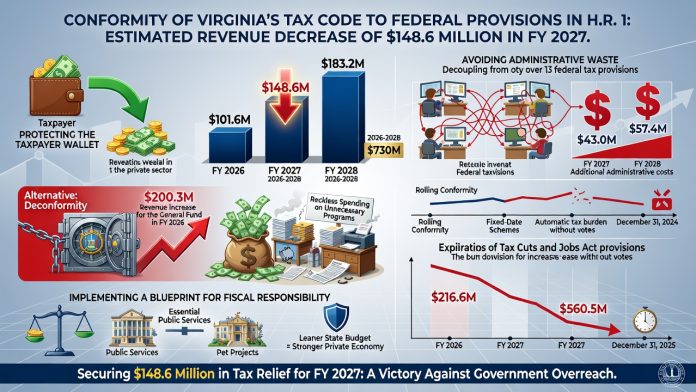
Virginia lawmakers are currently debating a critical budget measure that would conform the state tax code to federal provisions outlined in H.R. 1. This alignment is projected to result in a state revenue decrease of $148.6 million in fiscal year 2027, which translates directly into massive savings for hardworking citizens. By synchronizing state laws with federal tax relief, conservative leaders hope to restrict the expansion of the state budget. This approach effectively starves wasteful government programs of excess funding while keeping more wealth in the private sector.
PROTECTING THE TAXPAYER WALLET
The introduced budget assumes substantial conformity to recent federal tax changes, creating an escalating scale of financial relief for Virginia families and businesses. According to state projections, this policy will reduce government revenue by $101.6 million in fiscal year 2026, $148.6 million in fiscal year 2027, and $183.2 million by fiscal year 2028. While bureaucratic agencies label these figures as revenue decreases, fiscal conservatives recognize them as vital protections against state overtaxation. Overall, the proposed tax policy ensures that taxpayers save an estimated $730 million over fiscal years 2026 through 2028.
The alternative to this alignment involves aggressively deconforming state tax laws from federal codes to artificially inflate the state treasury. If lawmakers chose to deconform in fiscal year 2026, they would generate a potential revenue increase of $200.3 million for the General Fund. Funneling hundreds of millions of additional dollars into the General Fund typically encourages reckless spending and the creation of permanent, unnecessary government programs. Responsible fiscal management dictates that surplus capital belongs in the hands of the people who earned it, not in the coffers of Richmond bureaucrats.
AVOIDING ADMINISTRATIVE WASTE
Failing to conform to federal tax laws would unleash an administrative nightmare that ultimately penalizes the Virginia taxpayer. Legislation seeking to decouple the state from federal standards would deconform Virginia from more than thirty separate federal provisions spanning both individual and business tax regimes. Official analyses warn that such a move would have an unknown but highly significant impact on the administrative costs of the Department of Taxation. Forcing state employees to navigate a convoluted, dual-track tax system is a textbook example of government inefficiency and operational bloat.
The financial burden of this administrative chaos would be staggering, as massive operational costs would quickly shift directly to the state. Projections indicate that handling these misaligned tax frameworks would add administrative expenses of $43.0 million in fiscal year 2027 and $57.4 million in fiscal year 2028. Taxpayers should never be forced to fund a bloated Department of Taxation simply because lawmakers refuse to streamline the tax code. Maintaining strict conformity eliminates this wasteful overhead, ensuring that public funds are not squandered on redundant paperwork and bureaucratic processing.
DEFEATING FIXED-DATE CONFORMITY SCHEMES
Historically, Virginia maintained a system of rolling conformity with the Internal Revenue Code to guarantee a seamless tax filing experience for its citizens. However, recent legislative proposals like House Bill 977 sought to end this rolling conformity and replace it with a fixed-date standard set for December 31, 2024. This maneuver would effectively decouple Virginia from future federal tax reductions, setting a dangerous trap that automatically raises the state tax burden without a direct vote. Fiscal conservatives strongly oppose these fixed-date schemes because they provide a backdoor mechanism for politicians to increase revenues and expand government spending.
The urgency of maintaining tax conformity is further highlighted by the looming expiration of vital federal tax cuts. If all the Tax Cuts and Jobs Act provisions impacting the general fund were allowed to expire on December 31, 2025, the fiscal landscape would shift dramatically against the taxpayer. Under that expiration scenario, general fund revenue would have decreased by $216.6 million in fiscal year 2026 and $560.5 million in fiscal year 2027, demonstrating the volatility of relying on misaligned tax codes. Virginia must lock in permanent structural conformity to shield its economy from these massive, unpredictable swings in taxation.
IMPLEMENTING A BLUEPRINT FOR FISCAL RESPONSIBILITY
The introduced executive budget rightfully embraces substantial conformity to protect the economic competitiveness of the entire commonwealth. By matching federal tax relief measures, the state government is legally prevented from double-dipping into the wallets of local businesses and families. This intentional revenue restriction forces the legislature to prioritize essential public services rather than relying on an endless stream of surplus cash to fund pet projects. True fiscal conservatism requires lawmakers to operate within strict financial boundaries, and tax conformity provides the perfect mechanism to enforce that discipline.
In the end, a leaner state budget inherently fosters a stronger, more resilient private economy across Virginia. Securing the projected $148.6 million in tax relief for fiscal year 2027 is a necessary victory in the ongoing battle against government overreach and wasteful spending. Policymakers must firmly reject any attempts to inflate the state treasury through convoluted tax decoupling schemes. By embracing full federal conformity, Virginia can deliver historic savings to its citizens while permanently shrinking the footprint of the state bureaucracy.