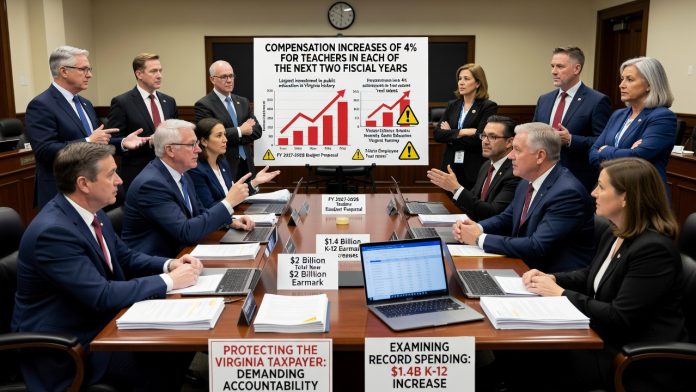
The newly proposed Virginia state budget introduces a staggering financial commitment to public education, raising serious concerns for fiscal conservatives focused on protecting taxpayer dollars. Lawmakers have approved a sweeping plan that includes a 4% salary increase for teachers and school support staff in both fiscal years 2027 and 2028. This aggressive spending strategy represents a massive expansion of the state government payroll that citizens will ultimately have to finance. Taxpayers are now left wondering how the state plans to sustain this unprecedented level of spending without eventually raising taxes or cutting essential services.
EXAMINING THE RECORD SPENDING
Digging into the exact figures reveals the sheer magnitude of this budgetary expansion, which includes a $1.4 billion increase specifically earmarked for K-12 education funding. When combined with other initiatives, the state is looking at nearly $2 billion in total new education funding, a historic sum that dramatically expands the size of the public sector. Alongside the 4% bump for school staff, state employees will also receive a 3.5% salary increase in each year of the biennium. This aggressive spending package completely abandons the more fiscally responsible 2% salary increase originally proposed in earlier versions of the state plan by former Governor Glenn Youngkin.
Fiscal conservatives have long warned that throwing massive sums of money at systemic issues rarely results in proportional improvements in educational quality or bureaucratic efficiency. While rewarding highly effective educators is a worthy goal, applying sweeping, across-the-board percentage increases often fails to differentiate between high performers and those simply occupying a position. The addition of nearly $2 billion in new education funding creates an enormous recurring expense that the state will be forced to maintain in all future budgets. Hardworking Virginians are effectively being forced to underwrite a rapidly inflating bureaucracy that lacks the necessary oversight to prevent rampant waste and administrative bloat.
DEMOCRATIC PRIORITIES AND PROGRESSIVE POLICIES
The Virginia House Democratic Caucus has openly celebrated this massive expenditure, characterizing the budget as delivering meaningful, targeted investments for the state. In their public statements, the caucus boasted that this represents the largest investment in public education in Virginia history while also pushing the state toward a $15 minimum wage by 2028. They further claimed that this inflated budget safeguards against future federal funding cuts, effectively shifting the burden of federal spending reductions directly onto the backs of state taxpayers. Tying historic education spending to progressive economic policies like aggressive minimum wage mandates signals a troubling departure from sensible, conservative fiscal management.
Despite the historic nature of this taxpayer-funded windfall, public sector union leaders are already signaling that these billions are simply not enough to satisfy their endless demands. Carol Bauer, President of the Virginia Education Association, stated that the 4% salary adjustments merely help school employees keep pace with the rising cost of living. Bauer argued that keeping up with inflation is not the same thing as providing a real raise, complaining that educators still struggle to afford basic housing costs. This predictable union response illustrates the inherent danger of capitulating to massive spending increases, as the demands for additional taxpayer money will never truly cease.
PROTECTING THE VIRGINIA TAXPAYER
Safeguarding the public purse must become the primary focus for lawmakers who are entrusted with managing the state’s financial resources responsibly. A sudden injection of $1.4 billion directly into K-12 public schools demands rigorous auditing to ensure these funds are not lost to fraud, waste, or unnecessary administrative overhead. Without strict conservative oversight, these historic budget increases will inevitably disappear into the bureaucratic machine rather than directly benefiting classroom instruction. Citizens have every right to demand that their government root out existing financial waste before asking the public to fund billions in new spending initiatives.
The stark contrast between this new budget and the original proposals from Glenn Youngkin highlights a highly concerning trend in Richmond regarding unchecked state expenditures. Youngkin initially proposed a modest, sustainable 2% salary increase that respected the limits of the state’s revenue streams without placing undue burdens on the local economy. By doubling that proposal to a 4% annual increase over two years, the current budget severely limits the state’s financial flexibility during potential future economic downturns. Responsible governance requires making difficult financial choices, yet this budget seemingly attempts to solve every perceived problem with an endless flood of taxpayer cash.
DEMANDING ACCOUNTABILITY FOR THE FUTURE
As Virginia prepares to enter fiscal years 2027 and 2028, the long-term consequences of this budgetary expansion will become increasingly apparent to local taxpayers. True conservative leadership demands a firm commitment to reducing overall state spending and ensuring that every dollar allocated serves a distinct, measurable, and essential purpose. Throwing billions of dollars at the public education system without demanding comprehensive structural reforms is a tremendous disservice to the hardworking families funding the enterprise. The state must prioritize fiscal restraint and accountability to prevent this historic spending spree from permanently damaging Virginia’s economic competitiveness.