
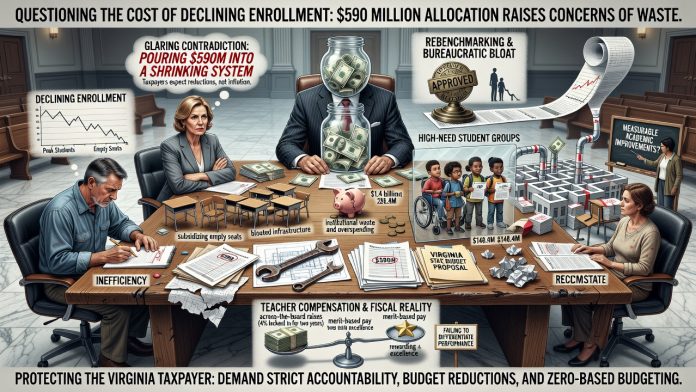
The latest Virginia state budget proposal includes a staggering $1.4 billion overall increase in K-12 public education funding compared to the previous budget cycle. Within this massive spending package, lawmakers have allocated $590 million specifically for rebenchmarking, high-need student groups, and, paradoxically, declining enrollment. For fiscally conservative taxpayers, pouring hundreds of millions of additional dollars into a system that is actively losing students represents a glaring contradiction in basic financial management. Hardworking citizens rightfully expect the state government to reduce spending when demand for a public service decreases, rather than artificially inflating the budget.
QUESTIONING THE COST OF DECLINING ENROLLMENT
The allocation of $590 million to address shifting school demographics and operational costs raises serious concerns about institutional waste and overspending. According to the advanced budget proposal, lawmakers explicitly earmarked these funds to soften the financial blow for school districts experiencing declining student populations. Subsidizing empty seats removes any incentive for local school boards to consolidate resources, close underutilized facilities, or streamline their administrative overhead. This approach effectively forces taxpayers to maintain a bloated educational infrastructure that no longer reflects the actual needs of the community.
Within this specific funding block, the state plans to direct $28.9 million toward at-risk student programs and $148.4 million toward special education students. While providing essential services for vulnerable and high-need children remains a core moral responsibility, these massive appropriations require rigorous financial oversight to prevent fraud and mismanagement. Historically, massive influxes of cash into specialized educational programs often end up expanding administrative bureaucracies rather than directly reaching the classrooms where teachers need the most support. True compassion requires ensuring that every single dollar is spent efficiently to yield measurable academic improvements for these specific student groups.
REBENCHMARKING AND BUREAUCRATIC BLOAT
The concept of rebenchmarking serves as a routine bureaucratic mechanism that consistently adjusts state education funding upward, regardless of actual academic performance. Lawmakers justified this latest round of funding by citing rising operational costs and the changing demographics within the public school system. However, fiscal conservatives argue that operational costs should be managed through strict efficiency measures and budget cuts, not by continually passing the burden onto the taxpayer. Accepting rebenchmarking as an unquestionable mandate allows the state government to operate without the fiscal discipline required of private businesses and household budgets.
The staggering $1.4 billion total increase in K-12 education funding highlights a dangerous trend of unchecked public sector expansion in Richmond. Throwing more money at a system experiencing declining enrollment defies basic economic principles and contradicts the core conservative value of limited government. Instead of continuously expanding the financial footprint of public education, state lawmakers should be actively looking for ways to return surplus funds to the taxpayers. A smaller student population must naturally equate to a smaller, more streamlined budget that respects the financial realities of hardworking Virginia families.
TEACHER COMPENSATION AND FISCAL REALITY
In addition to the rebenchmarking funds, the budget guarantees a four percent pay increase for teachers in each of the next two years. This mandatory salary hike is designed to build upon previous compensation adjustments, further locking the state into long-term, compounding financial commitments. While compensating effective educators is a valid priority, across-the-board raises fail to differentiate between high-performing teachers and those who are failing to meet basic academic standards. Implementing merit-based pay would be a far more fiscally responsible approach, ensuring that taxpayer dollars are used to reward excellence rather than simply funding tenure.
As inflation continues to squeeze the budgets of everyday families, the state government must prioritize immediate budget reductions and comprehensive tax relief. When public schools lose students to private education or homeschooling, their corresponding budgets should reflect that decline through proportional spending cuts. Protecting the taxpayer means aggressively rooting out fraud, eliminating unnecessary waste, and demanding that public schools operate within their established means. Lawmakers must stop treating the state treasury as an endless source of revenue for an ever-expanding administrative state.
PROTECTING THE VIRGINIA TAXPAYER
Virginia lawmakers must recognize that endless budget expansions are not the definitive solution to the complex challenges facing public education today. True educational reform requires structural changes that empower parents, increase financial transparency, and ultimately reduce the heavy tax burden on the state’s citizens. Until the state legislature adopts a zero-based budgeting approach for public schools, taxpayers will continue to foot the bill for systemic inefficiencies. It is time for conservative voices to demand strict accountability and a definitive end to the rubber-stamping of inflated educational budgets.
Moving forward, citizens must demand comprehensive, independent audits of the entire $590 million allocated for rebenchmarking and high-need groups. Without rigorous financial oversight, these massive appropriations remain highly susceptible to institutional waste and bureaucratic mismanagement at the local level. It is imperative that Richmond respects the taxpayer by trimming the excess fat from the education budget and returning to fundamental principles of fiscal restraint. Only through aggressive budget reductions and uncompromising accountability can Virginia ensure a prosperous economic future for its residents.