
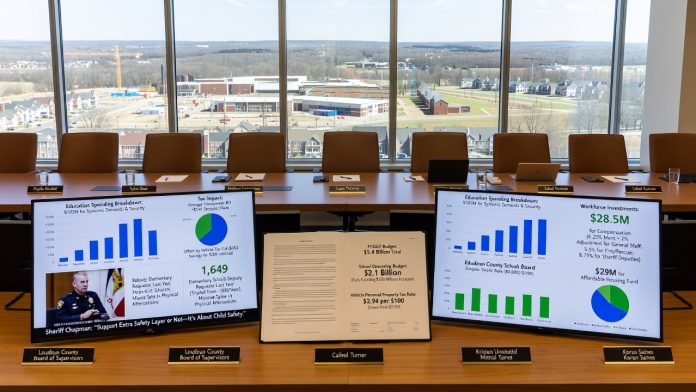
The Loudoun County government is advancing a massive financial blueprint for the upcoming fiscal year, featuring a historic investment in local education. The proposed FY2027 budget totals $5.4 billion and includes significant funding increases across multiple county departments. A central component of this financial plan is the allocation of $2.1 billion for the school operating budget. This figure fully funds a $105 million increase requested by local education leaders to address growing systemic demands.
These budgetary decisions fall under the purview of the Loudoun County Board of Supervisors and the Loudoun County School Board. The Board of Supervisors includes Phyllis Randall, Juli Briskman, Sylvia Glass, Laura TeKrony, Matthew Letourneau, Caleb Kershner, Michael Turner, Kristen Umstattd, and Koran Saines. Meanwhile, the School Board consists of Melinda Mansfield, Arben Istrefi, Anne Donohue, April Chandler, Deana Griffiths, Linda Deans, Kari Munro, Sumera Rashid, and Colin Doniger. Both boards are navigating the complexities of funding comprehensive public services while managing the financial burden placed on local taxpayers.
Education Spending and Safety Initiatives
The $105 million increase for Loudoun County Public Schools represents a substantial commitment to addressing both academic and security needs within the district. A significant portion of the public discourse surrounding this funding has centered on the deployment of School Resource Officers at the elementary school level. Proponents argue that the increased budget is necessary to handle a sharp rise in behavioral and security incidents across the county. Administrators and law enforcement officials have presented alarming statistics to justify the financial expansion and the integration of armed deputies in schools for younger children.
Sheriff Mike Chapman directly addressed the necessity of these security measures during recent budget discussions with county officials. Chapman stated that officials either support an extra layer of safety or they do not, emphasizing that the issue is strictly about child safety. Backing this perspective, Supervisor Kristen Umstattd noted that in the last year, there were 1,649 instances where an elementary school requested a deputy to manage a situation. This represents a drastic increase, as calls for service at elementary schools have reportedly tripled from roughly 500 per year, alongside a massive spike in physical altercations.
Tax Rates and Resident Impact
Funding the $5.4 billion FY2027 budget requires a careful balancing act regarding local taxation and revenue generation. The real property tax rate is slated to remain unchanged from the previous year at $0.805 per $100 of assessed value. However, despite the static tax rate, the average homeowner will still see their property tax bill rise by approximately $141. This increase is driven entirely by the continuing upward trajectory of residential property assessments across the rapidly growing county.
To help offset the rising costs of real estate taxes, the county has proposed relief in other areas of the tax code. The vehicle personal property tax rate is scheduled to drop to $2.94 per $100 of assessed value in 2027, down from the current rate of $3.09. This adjustment is expected to provide tangible financial relief for residents who commute or own multiple vehicles. For example, a resident with a vehicle assessed at $30,000 will experience an average tax reduction of $352 under the new fiscal plan.
County Workforce and Housing Investments
Beyond education, the FY2027 budget directs substantial resources toward retaining and expanding the county workforce through enhanced compensation packages. The budget allocates $28.5 million specifically for employee compensation funding to remain competitive in the regional labor market. General county employees will receive a 4.25 percent merit raise alongside a 2 percent salary adjustment. Furthermore, public safety personnel will see targeted boosts, with fire and rescue staff receiving a 5.5 percent average increase and sheriff deputies receiving an 8.75 percent average pay bump.
The comprehensive financial plan also includes $30 million in base budget adjustments and authorizes the creation of 188 new positions across various departments. Addressing another pressing local issue, the budget designates $29 million for the housing fund to support affordable housing initiatives throughout the jurisdiction. County Administrator Tim Hemstreet noted that the budget meets the guidance of the board while reflecting his recommendations on constraining budget growth. Hemstreet indicated that these constraints are necessary preparations for future economic uncertainties and long-term capital improvement projects.
The FY2027 budget ultimately reflects Loudoun County’s attempt to manage rapid growth while prioritizing education, public safety, and infrastructure. The fully funded $2.1 billion school operating budget underscores the local government’s commitment to its students and educational staff. Simultaneously, the investments in law enforcement and affordable housing demonstrate a multifaceted approach to community development. As the fiscal year approaches, officials will continue to monitor the practical impacts of these massive financial allocations on the community.
Email the Board of Supervisors at:
Phyllis J. Randall (Chair, At-Large) – Phyllis.Randall@loudoun.gov,
Michael R. Turner (Vice Chair, Ashburn District) – Mike.Turner@loudoun.gov,
Juli E. Briskman (Algonkian District) – Juli.Briskman@loudoun.gov,
Sylvia R. Glass (Broad Run District) – Sylvia.Glass@loudoun.gov,
Caleb Kershner (Catoctin District) – caleb.kershner@loudoun.gov,
Matthew F. Letourneau (Dulles District) – Matt.Letourneau@loudoun.gov,
Kristen C. Umstattd (Leesburg District) – Kristen.Umstattd@loudoun.gov,
Laura A. TeKrony (Little River District) – Laura.TeKrony@loudoun.gov,
Koran Saines (Sterling District) – Koran.Saines@loudoun.gov