
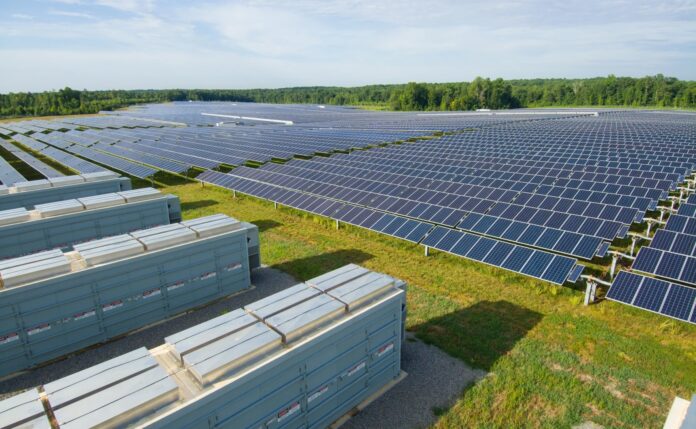
Virginia lawmakers want to more than triple the amount of energy storage capacity Virginia’s two public utility companies — Dominion and Appalachian Power (ApCo) — must procure under the Virginia Clean Economy Act (VCEA).
Passed in 2020, the VCEA required Dominion to supply electricity from only carbon-neutral sources by 2045. It gave ApCo until 2050 to meet the same standard. As part of its strategy to decarbonize the grid, the VCEA also set targets for public utilities to add capacity to store excess energy produced from renewable sources to dispatch during times of high demand.
House Bill 2537 and companion Senate Bill 1394 would increase targets set by the VCEA for Dominion and ApCo energy storage capacity from a combined 3,100 megawatts to 10,000 megawatts. Del. Richard Sullivan, D-Fairfax, who proposed HB 2537, said more energy storage would bring down energy costs — which Dominion projects will rise by 50% for its residential customers by 2039 — and help maintain grid reliability.
“This will position the commonwealth as a real national leader in developing energy storage … reduces the need to develop peaker plants, and ensures the best use of renewable technologies,” Sullivan said.
He added that increasing storage capacity “ensures the lights stay on for constituents during natural weather events.”
Sullivan’s bill passed the House 54-44 along mostly partisan lines, with two members not voting. The Senate version, brought by Sen. Lamont Bagby, D-Henrico, passed unanimously, with a nearly 50-50 bipartisan split. The two bills now await further action in the other’s chamber.
Dominion has warned that to keep up with increased power demand, it may need to build up to eight natural gas peaker plants — designed to be used when needed during demand peaks — over the next 10 to 15 years. Last year, Dominion announced plans to build a peaker plant in Chesterfield but has faced opposition from community members and environmental activists who say the plant could stall Virginia’s decarbonization mandates.
Investments in energy storage has paid off in other states. In Texas, through record summer heat waves in 2023 and winter storms in 2024, energy storage systems saved the state $750 million in energy costs and prevented grid shutdowns, according to separate analyses by Aurora Energy, energy market research consultants, and Clean American Power, a clean energy industry lobby. Renewables and energy storage batteries make up half of Texas’ energy mix, the Clean American Power report states.
Republican lawmakers in Virginia’s House are also concerned about rising energy costs but said investments to develop energy storage technology would mean additional costs to ratepayers. Del. Israel O’Quinn, R-Bristol, also took issue with VCEA requirements that public utilities pay penalties for not meeting clean energy goals, including battery storage requirements — costs that could be passed on to ratepayers.
“It’s time we step back and take a holistic look at where we are as it relates to utility regulations — as it relates to the ratepayers who are depending on us to try to make good decisions here and control the costs that are within our control,” O’Quinn said.
The bills require Dominion to apply for available federal Department of Energy grants to offset part of the development costs. Sullivan said investment in energy storage will bring future savings and is needed due to growing demand on the grid in Virginia. “We must increase storage development so that renewable energy produced at times it may not be needed can be stored to be put on the grid at the most useful time,” he said. “Investments in storage today will pay large dividends for ratepayers and grid stability for decades to come.”
Where is Dominion on energy storage?
Under the VCEA, Dominion, Virginia’s largest public utility, is required to procure at least 2,700 megawatts of energy storage capacity by the end of 2035. The utility’s first interim goal is to petition the State Corporation Commission by the end of this year for approval to bring 250 megawatts of storage capacity online. Dominion says it is ahead on its year-end target and has petitioned the SCC for 557.1 megawatts of storage capacity, much of which is operational. One megawatt of storage capacity can power 250 homes at peak output, Dominion says.
The utility’s 557.1-megawatt storage portfolio includes projects in various stages of development.
Across four facilities in Chesterfield, New Kent, Scott and Hanover, Dominion currently has 36 megawatts of battery energy storage capacity in operation, 16 megawatts of which pre-date the VCEA, so are not factored into Dominion’s storage targets.
Also factored into VCEA targets is an additional 78 megawatts of storage capacity in various stages of development at five facilities across Virginia, including a 50-megawatt facility at Dulles International Airport that when completed will be the largest storage facility in Dominion’s fleet. Dominion acquired an additional 459.1 megawatts of capacity through power purchase agreements.
How close is Dominion to meeting proposed storage targets?
In addition to increasing capacity requirements, the bills call on public utilities to acquire specific amounts of both short-duration and long-duration energy storage capacity. The bills define short-duration as less than 10 hours of generation, and long-duration as 10 or more hours.
Differentiating between short- and long-duration storage in Virginia code ensures that short-duration batteries are deployed soon to meet current energy needs, while long-duration technologies are being improved and developed, says Bennett Fuson, a spokesperson for American Clean Power.
“We’ve primarily seen short duration energy storage, we haven’t seen a significant roll-out of [long duration systems],” Fuson says. “What we do know is having the resources to hold more power that’s cheaply generated and dispatch it for longer periods of time to offset those costs does help … as we’re thinking about that next generation of energy consumers.”
If the new storage targets are adopted, Dominion would have a lot of catching up to do. By year-end 2045, Dominion would be required to petition the SCC to buy or purchase 3,480 megawatts of long-duration storage, half of which must be petitioned for by the end of 2035.
And half of the 2045 long-duration energy storage target capacity would be required to supply more than 24 hours of power. The legislation would also establish short duration energy storage capacity targets for 2045 and interim targets.
The SCC would have authority to determine the feasibility of the long duration energy storage targets and adjust the targets as needed. The SCC’s assessment would be based on a demonstration of pilot projects by Dominion that show energy storage technologies of at least 3,000 megawatts in capacity by 2029. Adopting new targets would depend on factors such as cost and reliability.
Dominion is working with energy storage developers to pilot three long duration storage projects, including two battery systems at its Darbytown Power Station in Chesterfield — one of which could potentially discharge energy for 100 hours, according to Dominion. But the pilots — a combined 12.3 megawatts — would make a very small dent in 2029 technology demonstration goals.
Christine Noonan, a lobbyist for Dominion, says the legislation would give Dominion the opportunity to study long-duration energy storage, which “could be an important tool for [grid] reliability going forward.”
“Ultimately, after that technology demonstration [in 2029] the commission will have full authority to agree with the targets set in the code or alter them up or down and we think that is the right approach,” Noonan adds.